The pendulum of such claims appears at present to be moving in favour of testamentary freedom. However, this is a broad proposition and each claim must be considered on its own merits. Mander J who delivered the reasons for the Court of Appeal to uphold the High Court decision in O’Neill v O’Neill sets out this view at [37] as follows:

O’Neill v O’Neill relates to second marriage with three adult children from the first marriage where the estate was modest comprising a half share in a house valued at approximately $500,000 and a small number of shares. The background is set out in the High Court decision as follows:
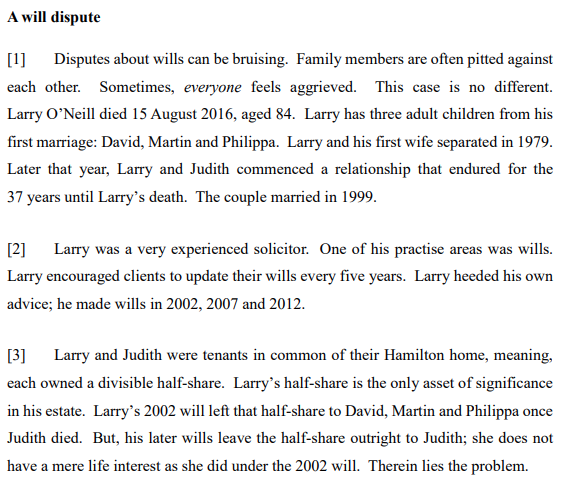
On appeal, (the High Court was not satisfied that there was a breach of the deceased’s moral duty finding a primary duty to his wife). Reference was made by the Court of Appeal to the practical realities of any award and that while 10% might be an appropriate award on account of support, this must be measured relative to what that means in the relevant case. See at [32] as follows:

Fault
In Bradshaw v Barry the Court found a breach of the duty owed by the deceased was not mitigated by the lack of contact between the deceased and the plaintiffs the estrangement being attributed to matters including the deceased’s failure to pay child support, which contributed to their difficult living circumstances when young.
References
- O’Neill v O’Neill [2020] NZHC 2988
- O’Neill v O’Neill [2021] NZHC 50 (costs)
- O’Neill v O’Neill [2021] NZCA 585
- Bradshaw v Barry [2024] NZHC 3287
 Matters of Trust
Comments are closed.