The Privy Council has allowed the appeal in Grand View Private Trust Company Limited v Wong. By way of background, the former individual beneficiaries of a substantial private discretionary trust sought to a challenge the trustee’s decision to appoint the Wang Family Trust (a perpetual purpose trust) as a new beneficiary, and to then transfer the entire trust assets (valued at in excess of US$560 million) to it. The beneficiaries as originally defined in the trust were the children and remoter issue of the Wang brothers (founders of the Formosa Plastics Group, a Taiwanese conglomerate). See Shaky Ground for further background.
The opening paragraph signals the direction the decision is taking. See [1], which provides:
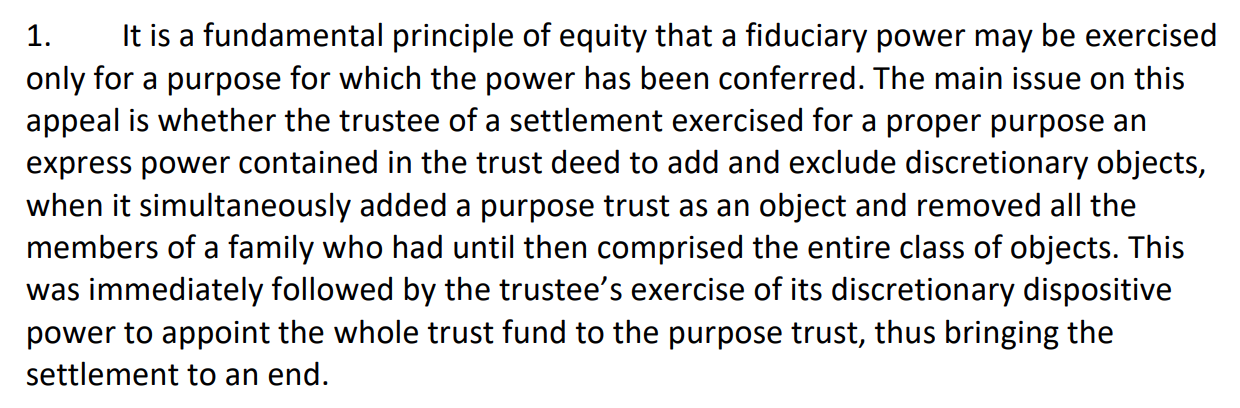
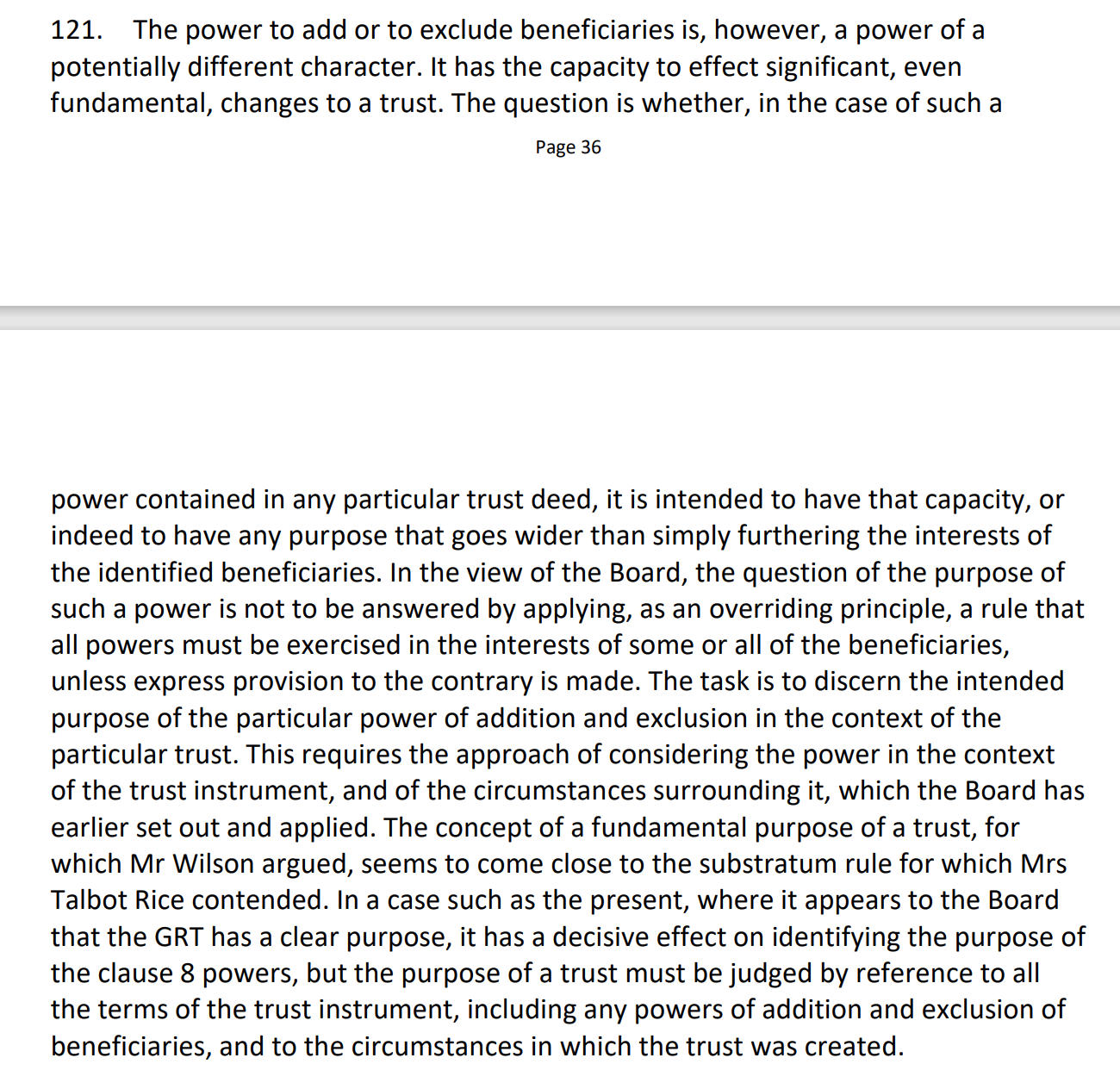
The fundamental question was the exercise of powers that allowed a beneficiary not named in the terms of a trust to benefit from the exercise of trustee powers. The conclusion was that the trustees had not exercised powers for a proper purpose, as is canvassed in the following [121]:
As noted by Anthony Grant, How the ‘proper purpose’ rule should be applied to trusts:
“The Privy Council’s reasoning is not confined to the power to remove beneficiaries. It extends to all powers that exist in a trust.
It will, for example, apply to a power to vary the terms of the trust.
The decision raises important questions about changes that will typically occur with a settlor’s intentions for the objectives of a trust.
At the time a trust is created, a settlor may generally intend that the purpose of a trust is X. But as decades go by, the settlor may intend that the trust is to fulfil purpose Y. A lesson from the Grand View case is that if a settlor wishes to preserve the right to change the purpose or objectives of a trust, he/she should use wording which enables a court to interpret the proper purpose of the trust as encompassing both purposes X and Y.
I suspect most New Zealand lawyers are not aware that the “proper purpose” doctrine has been expressly embedded in the Trusts Act 2019. It can be seen from ss 4(a), 21, 26(b) and 27. Sections 4(a) and 21 provide that trustees must have regard to the objectives” of a trust. These will align closely with a trust’s “purpose”. Section 26(b) provides that “a trustee must… further the permitted purpose of the trust…” Section 27 is the most significant of the provisions in the Trusts Act. This provides that “a trustee must exercise the trustee’s powers for a proper purpose”.
Because New Zealand courts have tended to focus on the words “fraud on a power” and not on the words a “ proper purpose”, I think it likely that many practitioners will be less familiar with the requirement that trustees must exercise powers only “for a proper purpose”.
The Privy Council’s decision in the Grand View case can be seen as an illustration of the requirements of s 27. Although trustees may have powers to amend a trust, to resettle it, to appoint and remove trustees, to appoint and remove beneficiaries and so on, none of these powers can be safely exercised unless it is aligned with “the proper purpose” of the powers. ■
References:
- Grand View Private Trust Company Limited v Wong UKPC [2022] 47
- Grand View Private Trust Company Ltd v Wong Civil Appeal No 5A of 2019
- Pitt v Holt [2013] 2 AC 108
- Re Manisty’s Settlement [1974] Ch 17
- Vacher v Paul [1915] 1 A..C. 372, 379
- Arnold v Britton and Wood v Capita Insurance Services Ltd [2017] UKSC 24
- Anthony Grant, “How the ‘proper purpose’ rule should be applied to trusts” published in the Law News May 12, 2023, Issue 14:
 Matters of Trust
Discussion
No comments yet.