The most recent decision in the long-running Lambie Trustee Limited v Addleman relates to costs on account of a judgment of the Supreme Court delivered in 1 June 2021. In that judgment as noted in the case in hand at [1] “.. with one clarification, the Court
dismissed an appeal brought by Lambie Trustee Ltd (LTL). The judgment addressed issues arising from the application by the respondent, Mrs Addleman, for disclosure of trust documents. In particular, the judgment dealt with whether LTL could resist
disclosure of legal advice on the basis of legal advice or litigation privilege…”
Costs were reserved. Submissions on costs raised these questions set out at [2]:

Mrs Addleman sought reimbursement of her actual costs and an order that Lambie Trustee Limited (Lambie Trustee) personally reimburse the Lambie Trust for any costs payable by Lambie Trustee. Mrs Addleman also seeks orders that Lambie Trustee (referred to by the Court as LTL) “…is not entitled to any indemnity for costs or expenses incurred in relation to the proceeding, including both its own legal fees and any costs due to Mrs Addleman.”
Editor’s note: it appears that Lambie Trustee is a special purpose trustee company of which Mrs Addleman’s sister Annette is currently the sole director and shareholder. While this company may have assets on its own account, as a general observation the sole asset of most special purpose corporate trustees is the company’s right of indemnity pursuant to the trust for which that company is a trustee.
The relevant background is set out at [5] and [6] as follows:
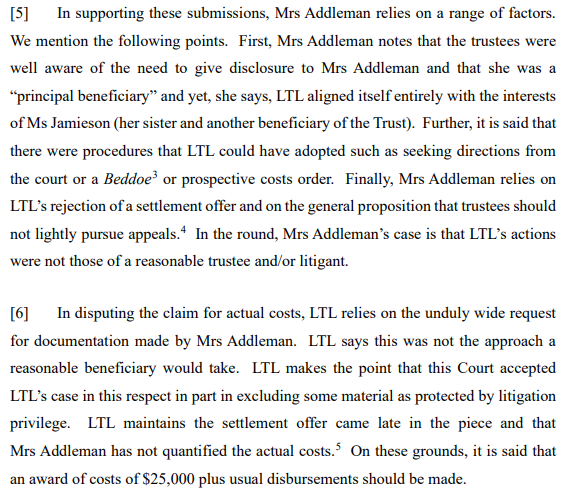
As noted at [8]:
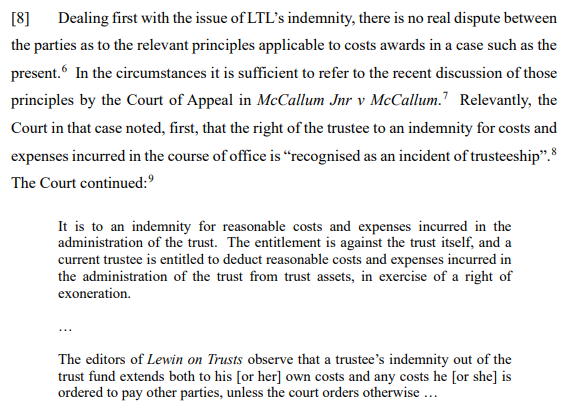
Importantly, a trustee’s right to indemnity applies to costs “properly incurred.” See New Zealand Māori Council v Foulkes. As noted in McCallum Jnr v McCallum “Careless and unreasonable conduct in the conduct of litigation” may deprive a trustee of rights of indemnity. Also stated in McCallum “[a] trustee partisan in his [or her] own interests or the interests of only some beneficiaries likewise may be deprived of indemnity.”
The Supreme Court has previously noted the “possibly inappropriate decision” of LTL “to align itself so closely with the interests of Ms Jamieson”. Given that Ms Jamieson is the sole director and shareholder of this trustee, the issues of alignment perhaps warrant further enquiry.
Ultimately, the Supreme Court took a practical approach to costs in the relevant proceedings and ordered as follows:


Editor’s note: On the face of it, this decision is redolent of the idea of another bad day for trustees. The corollary consideration is that if Lambie Trustee has no assets on its own account does this mean that the next step will be an application for the liquidation of that company should it fail to meet the costs order and a statutory demand on account of such costs? This then raises the question of the director’s culpability for such costs (see Vance v Lamb) and the implications of section 105 of the Trusts Act 2019.
In Andrew J’s subsequent 2024 High Court decision in Addleman v Lambie it was noted that the total amount of costs owed by the trustee to the Trust on account of the Supreme Court costs order was $1,959,885.35. As further noted in that decision at [16] and [17]:
[16] “… Lambie Trustee Ltd did not have the funds to repay those amounts owed to the Trust. Ms Jamieson, its director, then offered to provide the Trust with a guarantee for the full amount of costs claimed, secured by a mortgage.
[17] LITL further advised that as of 31 May 2024, it has recovered $1,734,885.35 with $225,000 outstanding. It expects to recover the outstanding $225,000 by 20 September 2024, by way of four monthly payments from Ms Jamieson.”
References:
- Lambie Trustee Limited v Addleman [2023] NZSC 7
- Lambie Trustee Limited v Addleman [2021] NZSC 54
- New Zealand Māori Council v Foulkes [2015] NZHC 489
- McCallum Jnr v McCallum [2021] NZCA 237
- Vance v Lamb [2008] NZHC 1902
- Addleman v Lambie Trustee Limited & Ors [2024] NZHC 1790
 Matters of Trust
Discussion
No comments yet.