Principles of tikanga and trust law are both inextricably linked with land ownership and benefit from land ownership.
That said, care is required when equating tikanga principles with a generic concept of Pākehā law.
Doney v Adlam provides a practical example of the tensions between Pākehā law and tikanga principles. The background to this case is set out in Breaches of trust will not be rewarded.
Ellis v R has highlighted the relevance of tikanga principles. However, it cannot be presumed that tikanga can be expected to fill every legal void. In Doney v Adlam Harvey J notes that :

At [76] Harvey states by reference to Ellis v R that ” … the applicability of tikanga will be determined by the nature of the case and its subject matter, and that tikanga will not always have controlling relevance. It may also be part of an array of considerations because the circumstances will be highly relevant…”
Fundamentally Doney v Adlam relates to a claim for moneys and land obtained in breach of trust to be accounted for.
While tikanga may be applicable, there needs to be a specific path to this, rather than a generic consideration. As noted in Doney v Adlam at [110]:

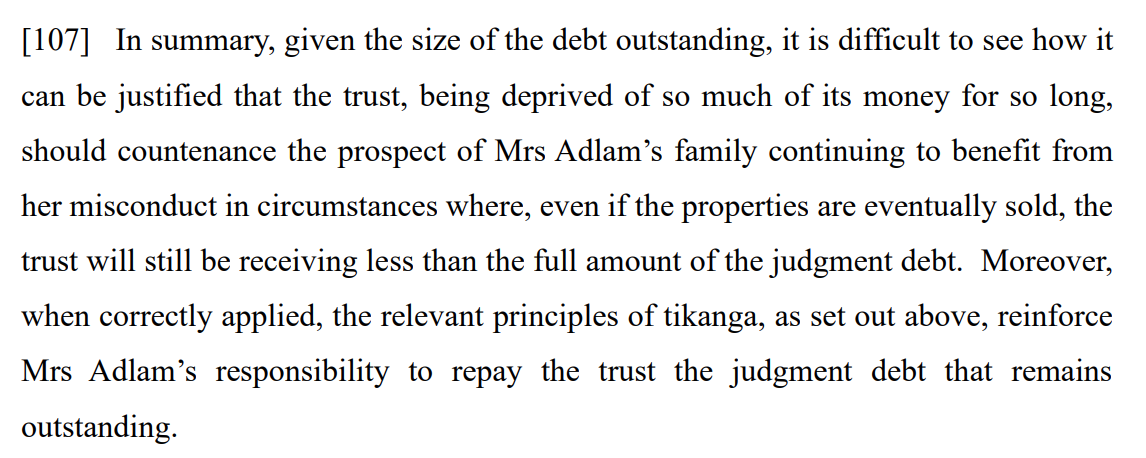
More specifically as noted at [107]:
Also see Adams v Adams where the deceased’s granddaughter sought to be joined to proceedings relating to a claim in respect of an estate property that was transferred to what may be a trust (this matter to be determined in the substantive proceedings). The applicant did not assert any legal rights in respect of the estate property, but wished “to be heard regarding what should or might happen with the property in the future.”
The court’s view of the matter and reasons for the decision to deny joinder are set out at [28] to

References
- Walters v Wikiriwhi [2022] NZCA 93
- Doney v Adlam [2023] NZHC 363
- Adlam v Savage Maori Appellate Court of New Zealand 2014/1; 2014/4
- Ellis v R [2022] NZSC 114
- Adams v Adams [2023] NZHC 608
 Matters of Trust
I’m a layperson who has a little more than most experience with a few law ‘things.’ I have set up three Trusts: for my parents, son and sister.
I would appreciate any insights or caveats which you can offer.
A very dear part-Maori friend (a sickness beneficiary) has asked me a few questions about her family Trust – set up by her deceased father. A Trust that she avers is now in a state of some chaos.
She said there are good reason to believe that some dubious dealings have occurred, including the forging of a signature to operate on the Trust’s bank account.
I said that she should ask a Trustee for:
1) the name of the Trust
2) a copy of the Trust Deed (incl any variations)
3) a list of current and past Trustees
4) a copy of the most recent fiscal stmts
I’ve told her that – as a beneficiary – my understanding is that the Trustees are obliged under the 2019 Act to provide those things.
I have also suggested that she take care, as inter-family disputes and rifts may not be worth whatever effort is made.
With that preamble, my salient question is: are there any significant differences between Trusts for people of part-Maori descent and the rest?
Also, please correct any of the suggestions I describe which I have put to her.
Posted by Simon | May 1, 2024, 8:23 pm