Gorringe v Pointon is a successful appeal of a High Court decision; the Court of Appeal finding that the deceased’s final and penultimate wills were more probably than not procured by undue influence.
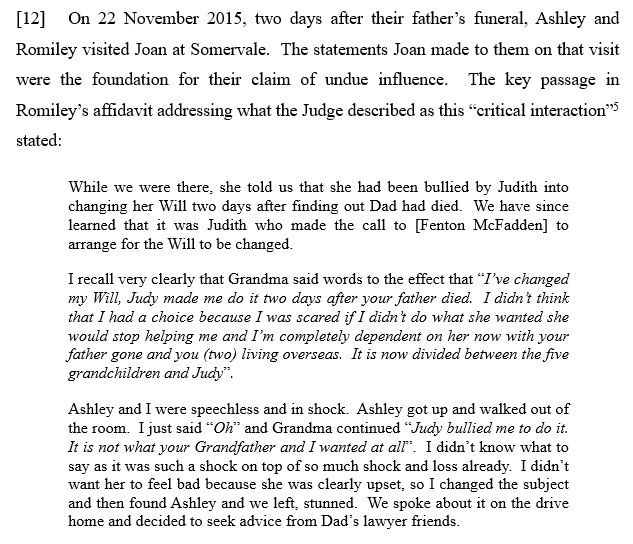
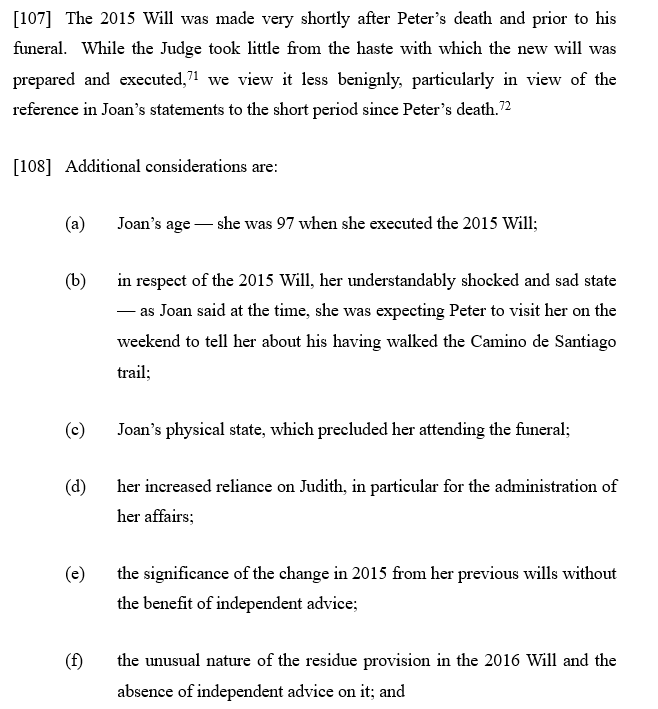
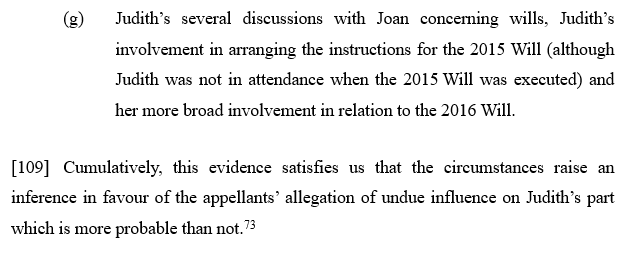
The circumstances relating the two wills found to be procured by undue influence are summarised follows:

With respect to undue influence as noted at [158] in the High Court decision in Gorringe v Pointon:
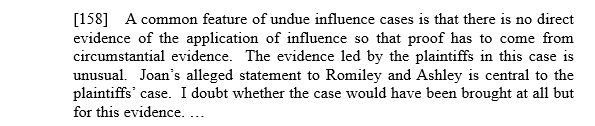
The statement perhaps highlights the risks of being polite and not trying to drill down in a manner that might be viewed as disrespectful. These comments are the writer’s observation and are not based on any knowledge of the circumstances. Nevertheless these thoughts relate to the need to balance social convention against the opportunity to throw a life-line to someone seeking help in difficult circumstances.
Burden of proof
Unhelpfully the burden of proof is not straight-forward in matters relating to wills. As stated by the Court of Appeal at [21] to


The Court of Appeal confirmed that the standard preferred was the test articulated by the Court of Appeal in Green v Green at [47]:

Test for undue influence
A person asserting undue influence has the burden of showing that the alleged influence led to the making of the impugned transaction. It must also be shown that that the influence was undue in the sense that the transaction was not the result of the free exercise of an independent. This means that there is a two part test.
Step one is showing the undue influence that let to the impugned transaction.
Step two is to show that undue influence had the effect of defeating free will.
What this means is that there may be undue influence, but that influence does not have the effect of directing conduct – the decision could be made regardless.
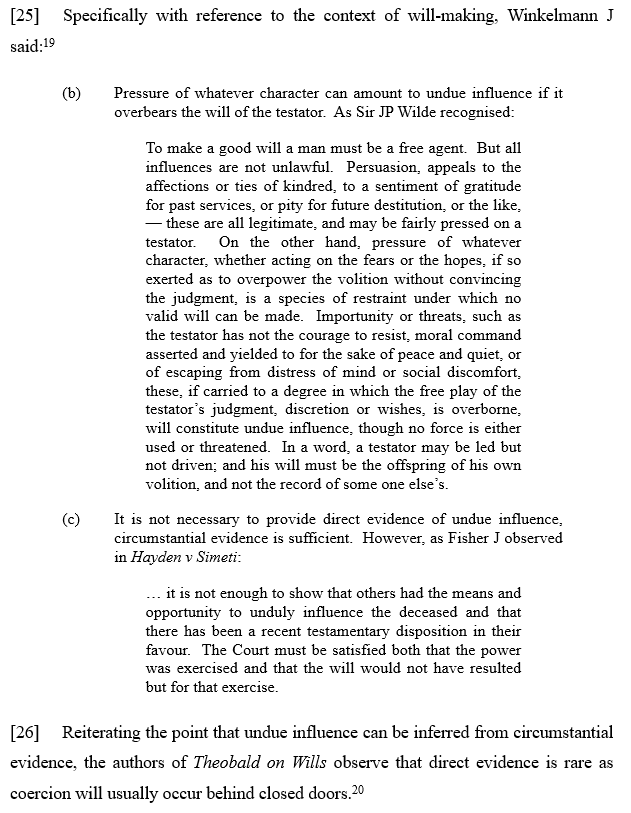
The following statement of Winkelmann J from Green v Green is illustrative:
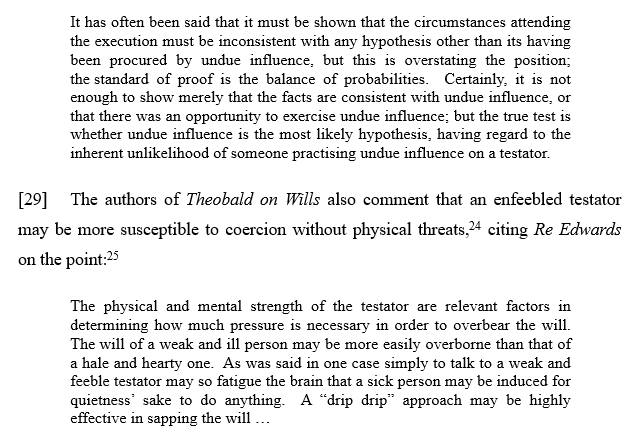
Also see Theobald on Wills, referred to in Gorringe v Pointon:
The decision in Gorringe v Pointon is necessarily fact specific. A takeaway observation is the importance of good will hygiene. While any will-maker can make a will that conforms with the Wills Act 2007 any professional taking will instructions must consider the possibility of undue influence, whether the will-maker has testamentary capacity as well as a wide-range of other matters that comprise will advice. Too often wills are relegated to junior staff members, in large part because very few professionals charge a fee commensurate with the work required to properly execute a client’s instructions in light of the risk to both the adviser and the client.
Any adviser taking will instructions where the will-maker has suffered a recent loss would be well advised to carefully consider the will-maker’s ability to give appropriate instructions. It is not the job of the adviser to permit a will to be made or not, but it is the job of the adviser to do that. Advise. In this regarding the concluding comments of the Court of Appeal are set out in full:
References:
- Gorringe v Pointon [2023] NZCA 42
- Gorringe v Pointon [2022] NZHC 342
- Green v Green [2015] NZHC 1218; Green v Green [2016] NZCA 1486
- Mahon v Mahon [2015] NZHC 2143
- Re Keast [2015] NZHC 1072
 Matters of Trust
Discussion
No comments yet.