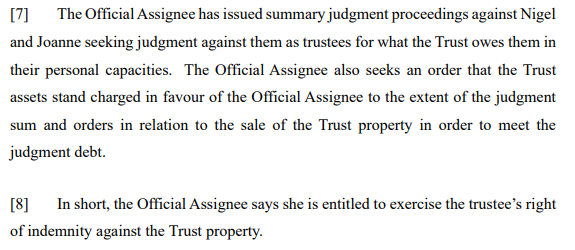
Asset protection is a common reason for settling assets onto a trust. However, where there are debts owing from trustees back to the settlor, these debts remain an asset in the settlor’s hands. How such debts are treated following bankruptcy is explored in the Official Assignee v Black. In that case Nigel Black (Nigel) and Joanne Black (Joanne), who had both been adjudicated bankrupt, were each personally owed approximately $291,000 by themselves as trustees of the Mountain Meadows Trust (the Trust). As set out at [7] and [8]:
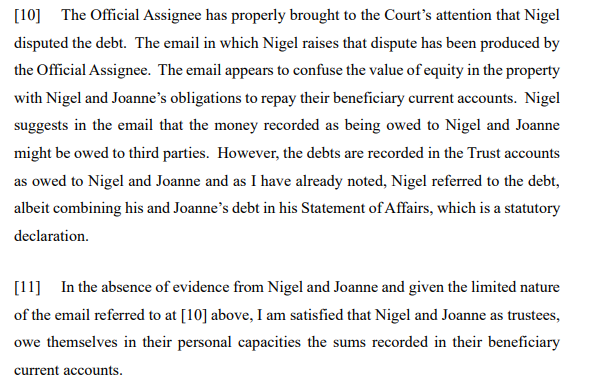
Although Nigel disclosed that the Trust owed him $580,000 in a Statement of Affairs, after the Official Assignee made demand for payment, Nigel disputed the debt. As stated at [10] and [11]:
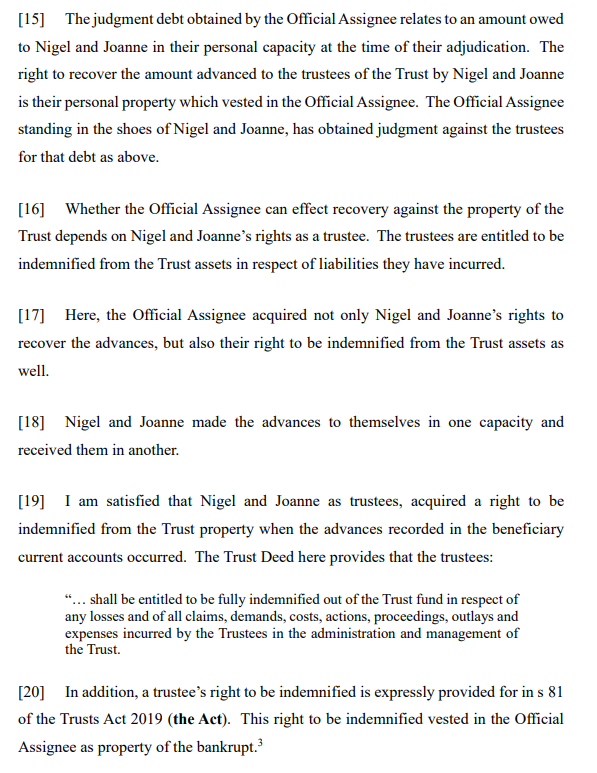
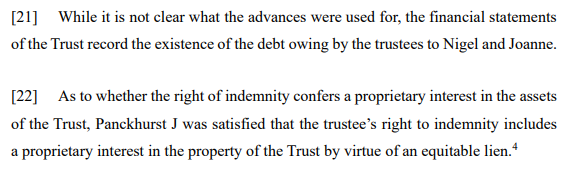
Judgment was entered against Nigel and Jane in their capacity as trustees. The next step for the court was to consider whether having obtained judgment against Nigel and Jane as trustees, the Official Assignee could exercise Nigel and Jane’s rights as trustees to be indemnified from the Trust. To address this Associate Judge Lester noted that he gratefully adopted Panckhurst J’s analysis from Official Assignee v Smith stating at [15] to [22]:
The end result was an order for the sale of the Trust property on account of the judgment against Nigel and Joanne as trustees.
References:
- The Official Assignee v Black [2023] 1331
- Official Assignee v Smith [2013] NZHC 3217
- Trusts Act 2019, s 81
 Matters of Trust
Discussion
No comments yet.