McLauglin v McLauglin relates to claims regarding the management of a family trust and the cost consequences of the proceeds, which are significant.
The background of the matter is summarised by French J, who delivered the Court of Appeal’s decision as follows:

The trust that is the subject of these proceedings, the Ashely Trust (the Trust), was settled by Jim and Edna in 2004 for the specific purposes of owing and developing land in the Nelson Region, the terms of the Trust specifying that:

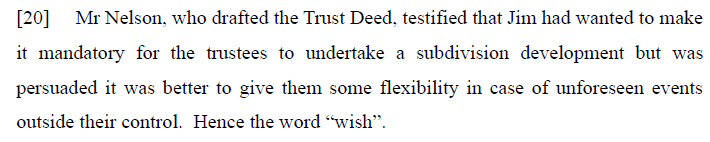
As noted at [20] and [23] to [25]:
…
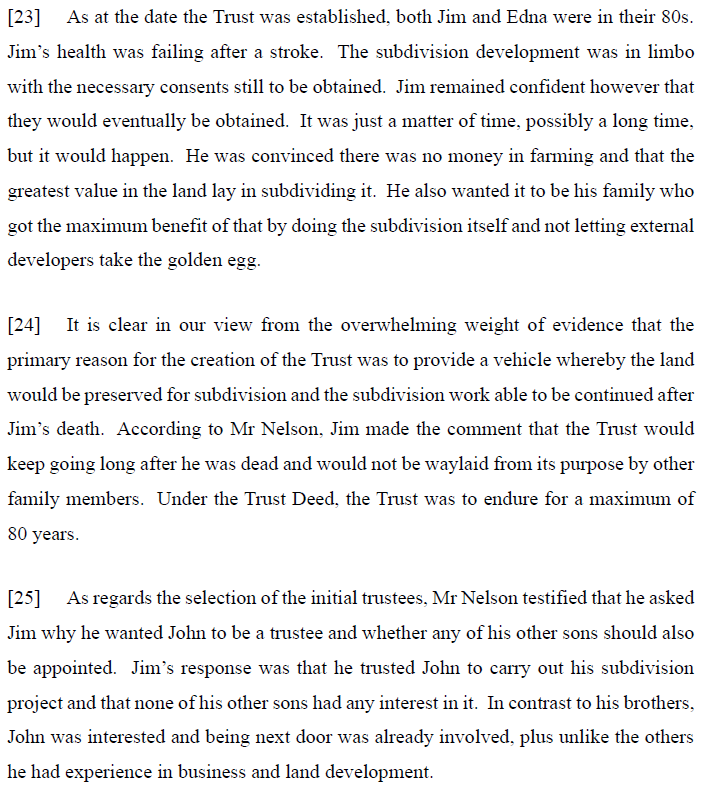
John was an actively involved trustee who personally guaranteed trust borrowings of up to $3.7million. As noted at [35] “Had he not done so, the Trust would not have been able to proceed. In evidence John said he was prepared to provide the guarantee with the comfort that he could ensure the subdivision was properly managed.”
Notwithstanding his personal exposure, John also invested hundreds of unpaid hours of his time up until 2008 when John proposed that he be contracted to manage the property development.
As a practical observation as noted at [45]:

Clause 13 of the terms of the Trust permitted John to receive payment as a project manager despite the fact that he was a trustee. In fact John provided services though a company.
It is clear that fees to be charged on account of John’s services were discussed by the trustees. As stated at [53] to [54]:

The above passage highlights the importance of all trustees being aware of when unanimity is required, and how any perception of any conflict might be managed while ensuring compliance with trust terms. In this regard, also see Dever v Knobloch and Unanimity and avoidance of self-dealing – care required.
Although John’s management fee was approved, as the Trust could not pay John, the contract was not signed to avoid the imposition of a liability the Trust could not meet. Instead a Heads of Agreement was entered into.
In or about 2011, John’s brothers Mark and Andrew became concerned about the property development. The Trust’s trustees took proactive steps in the face of this and as noted at [62]:

Further in 2014 the trustees made distributions totaling $550,000 to each of John and his brothers.
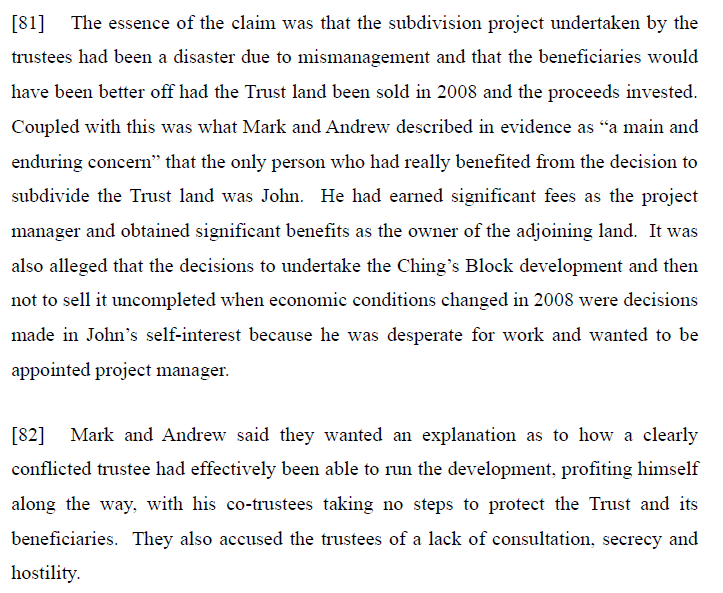
Regardless, discontent simmered and proceedings were issued in 2017. As noted at [81] and [82]:
See Balance of convenience is best interest of beneficiaries regarding the High Court hearing, the decision of that court being the subject of the current proceedings.
John resigned as a trustee late in the High Court proceedings, which resulted in a costs finding against him. The High Court proceedings otherwise found in favour of John.
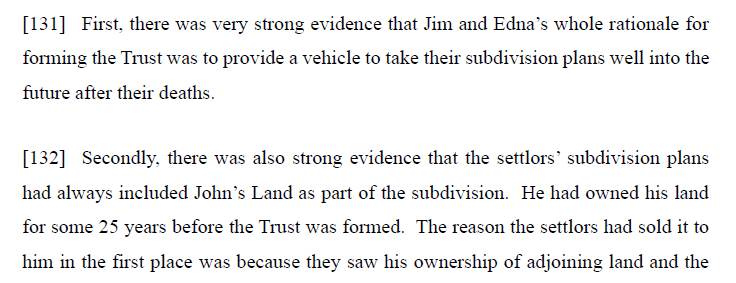
The Court of Appeal traversed the law regarding self-dealing concluding that John had no relevant conflict. As noted at [131] to [135]:

With respect to remuneration on account of John’s services the Court of Appeal found in favour of John following a careful review of the terms of the Trust and the reasonableness of the remuneration.
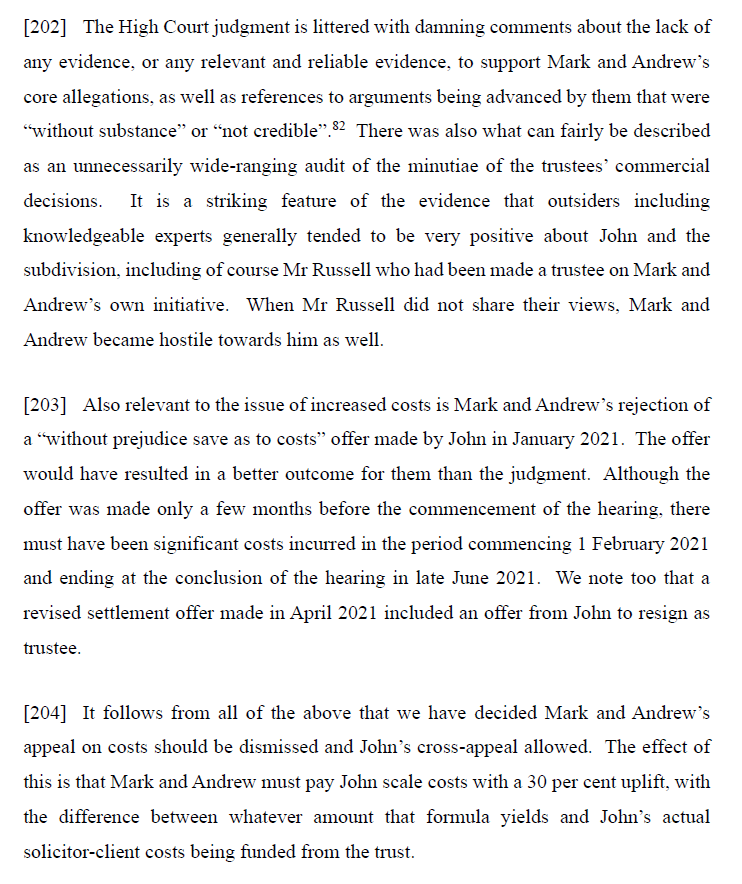
The sting in the tail was costs. The Court of Appeal overturned the 20% share of costs awarded against John on the basis that his late retirement did not significantly increase Mark and Andrew’s costs. As noted at [197] to [198] and [202] to 204]:

…
References:
- McLaughlin v McLaughlin [2018] NZHC 3198
- Glasgow Harley Trustee v McLaughlin [2018] NZHC 29
- McLaughlin v McLaughlin [2019] NZHC 2561
- McLaughlin v McLaughlin [2023] NZCA 473
- Dever v Knobloch (2009) 2 NZTR 19-042
 Matters of Trust
Discussion
No comments yet.