Re Candida Trust provides practical guidance as to the scope of section 125 of the Trusts Act 2019 and the use of the High Court’s inherent jurisdiction to permit trustees to sign a new restated trust deed that incorporates varied terms.
Background facts
- the Candida Trust (the Trust) will vest in the settlor’s children Stephanie, Antonia and Sibilla (with provision for substitution of grandchildren) on the death of the settlor’s wife
- the court was satisfied that this was not the deceased settlor’s intention
- the tax consequence of vesting will be significant due to accumulated depreciation of over $3.3m, which would be a significant burden for the Trust
- the Trust’s default beneficiaries are the settlors brothers and sisters with provision for nieces and nephews in substitution (the remoter beneficiaries)
- a 2013 variation to extend the Trust’s vesting day was ineffective as it was not signed by the remoter beneficiaries
- the proposed variations were significant. In this regard the court referred to Re Drummond where a similarly extensive deed of variation was approved on behalf of minors and unborn beneficiaries under section 124 of the Trusts Act 2019 in recognition, amongst other things, of the benefits in updating the trust deed in light of modern drafting practice and the Trusts Act.
Waiver pursuant to section 125 of the Trusts Act
As set out at [22] and [23]:
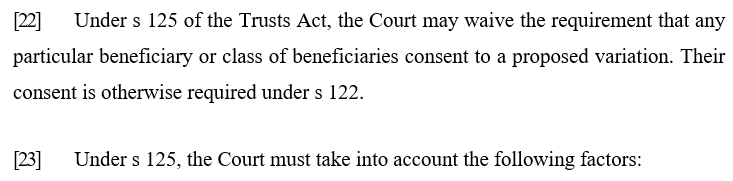

Scope of section 125 of the Trusts Act
As noted at [29]:

Importantly, as noted at [24] (above) the scope of section 125 appears to have some constraints and is to ensure only that remote or negligible interests will not stand in the way of beneficiaries with far more significant interests.
Inherent jurisdiction
The court was satisfied that drafting imperfections aside, the grandchildren were no longer final contingent beneficiaries. Consent was not given on their behalf pursuant to section 124 of the Trusts Act, rather the Court addressed this through an order pursuant to its inherent jurisdiction “confirming that the grandchildren of the settlor are not required to consent to the deed of variation…”
Separately the Court made a direction pursuant to the inherent jurisdiction that the trustees may sign a new restated trust deed incorporating the deed of variation that can be used as the trust’s operating document.
Also see How the courts can vary the terms of a trust.
References:
- Re Candida Trust [2024] NZHC 976
- Trusts Act 2019, ss 81 and 125
- Saunders v Vautier (1841) 4 Beav. 115
- Re Drummond [2023] NZHC 847
- Ruby v Ruby [2022] NZHC 282
- Re Jury [2022] NZHC 568, Re Tau [2023] NZHC 2544
- Talijancich v Talijancich [2021] NZHC 753
- Law Commission, Review of the Law of Trusts: A New Trusts Act for New Zealand (NZLC R130, 2013) at [10.14].
 Matters of Trust
Discussion
No comments yet.