The current decision in the long-running case of Addleman v Lambie Trustee Limited & Ors relates primarily to whether the Court should order that the parties attend mediation pursuant to section 145 of the Trusts Act 2019.
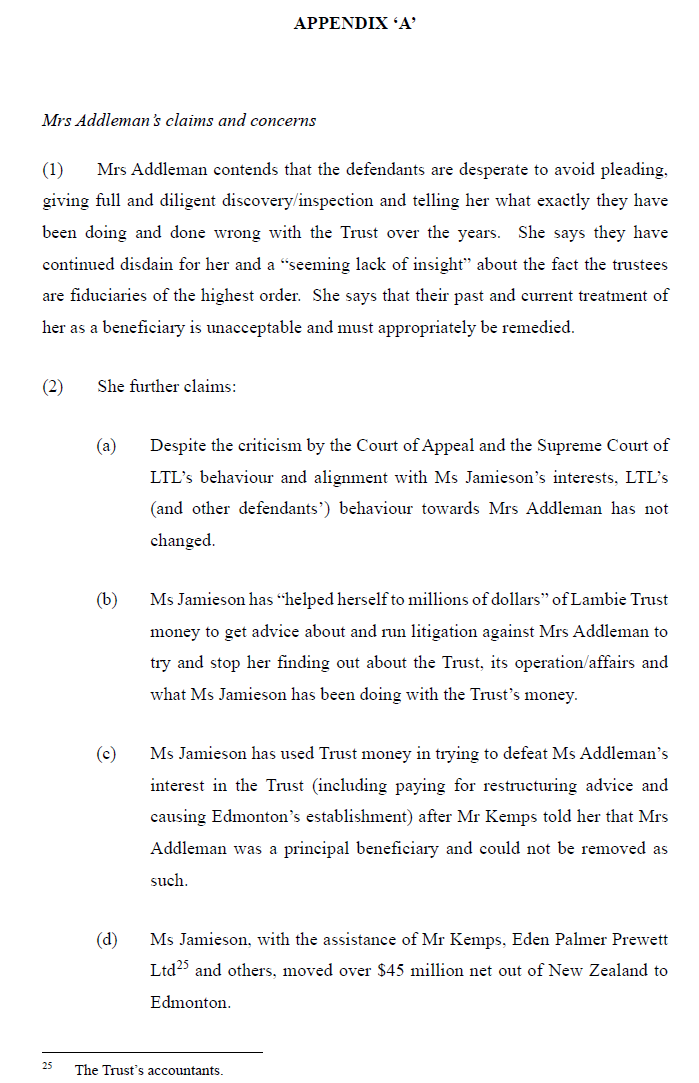
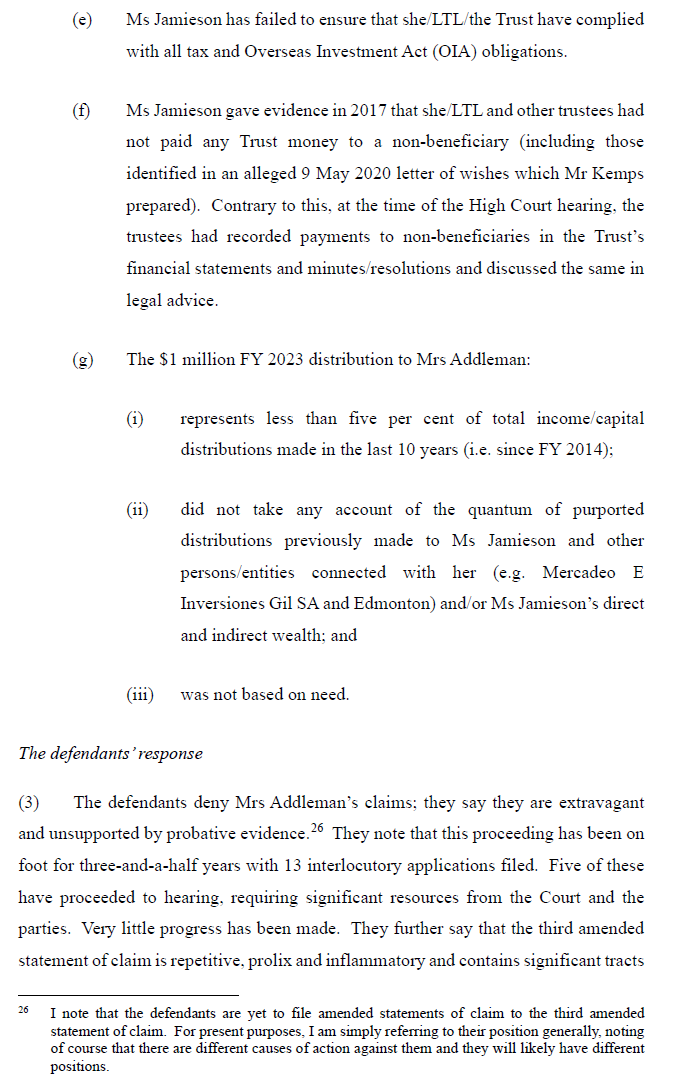
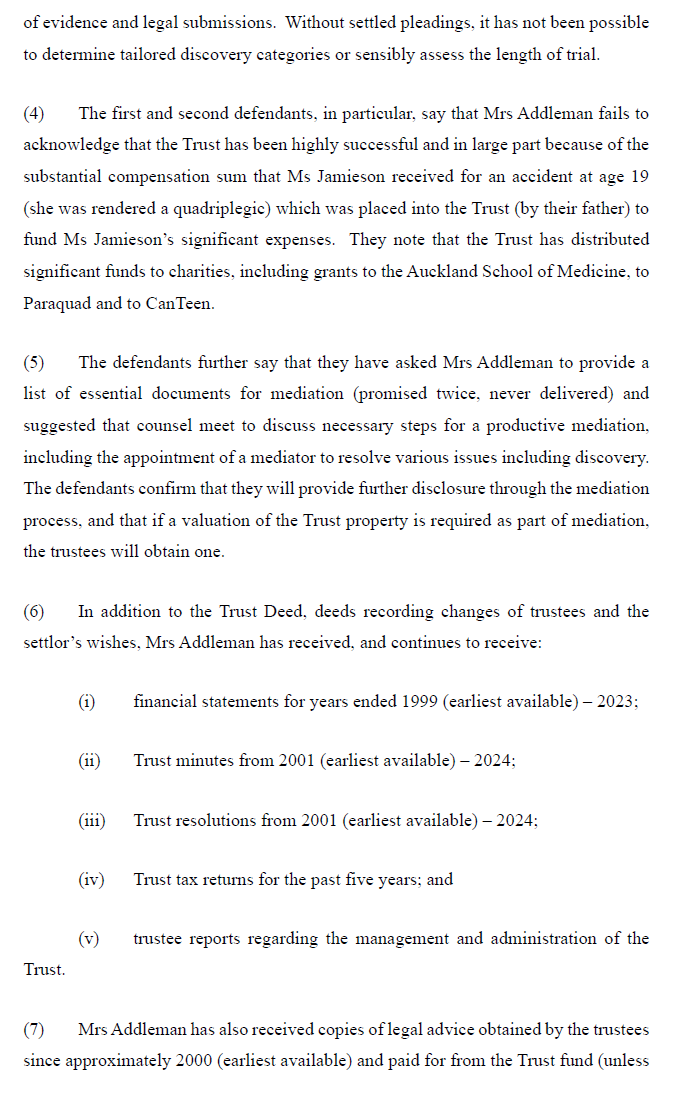
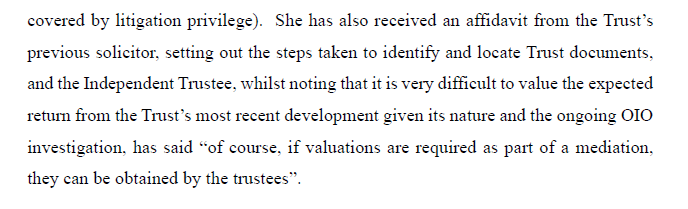
An appendix to the above decision (copied below) sets out a summary of Mrs Addleman’s concerns regarding the administration of the Lambie Trust and provides some helpful background and context.
With respect to the ambit of section 145 of the Trusts Act the following points are made by Andrews J:
- the power under s 145 is a power to order an alternative dispute resolution (ADR) process. That is also defined in broad terms in s 142. It includes, but is not confined to, mediation or arbitration
- one of the purposes of the Trusts Act is to provide for mechanisms to resolve trust-related disputes including referral to ADR
- in exercising powers under the Trusts Act, the Court is required to have regard to the principle that a trust should be administered in a way that avoids unnecessary cost and complexity. {Editor’s note: Given that the estimated hearing time for this matter is 8 weeks, the case for referral to ADR is compelling in light of this principle.]
- the proceedings in Addleman v Lambie largely relate to internal matters including the appointment of trustees; interpretation of the Trust Deed; allegations of conflict and self-dealing; failure act in an even-handedness fashion; negligent investment of the trust fund; payment to alleged non-beneficiaries; failure to keep accounts and trust records and failure to disclose trust information. Accordingly, the matters in dispute are “internal” as that term is defined for the purposes of s 145 of the Trusts Act
- concerns regarding disclosure are no barrier to an order of ADR. As noted at [36]: “the defendants agree to be bound by any direction of the mediator that they provide disclosure. Disclosure issues will, of course, not be unfamiliar to any experienced mediator. I further note that the court-appointed independent trustee has a right of access to Trust documents.”
- the jurisdiction under s 145 is discretionary
In conclusion as noted at [38] and [39]:


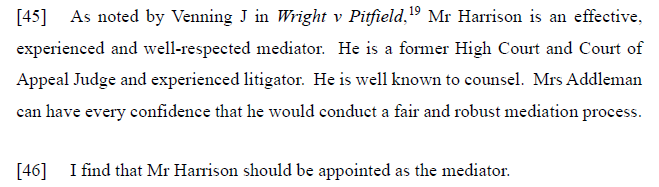
With respect to the appointment of mediator Andrews J states as follows:

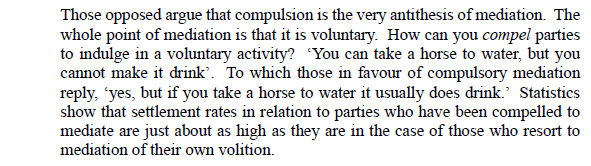
The following excerpt from the speech by Lord Phillips, the Lord Chief Justice of England and Wales in 2008 offers some measure of support for ADR even when Court ordered:
References:
- Lambie Trustee Limited v Addleman [2023] NZSC 7
- Lambie Trustee Limited v Addleman [2021] NZSC 54
- New Zealand Māori Council v Foulkes [2015] NZHC 489
- McCallum Jnr v McCallum [2021] NZCA 237
- Vance v Lamb [2008] NZHC 1902
- S v N [2021] NZHC 2860, [2021] NZFLR 756
- Wright v Pitfield [2022] NZHC 385
- Lord Phillips of Worth Matravers, Lord Chief Justice of England and Wales “Alternative Dispute Resolution: an English Viewpoint” (India, 29 March 2008).
- Addleman v Lambie Trustee Limited & Ors [2024] NZHC 1790
- Appendix A of Addleman v Lambie Trustee Limited & Ors [2024] NZHC 1790
 Matters of Trust
Discussion
No comments yet.