Innes v Darlow relates to an application for an order referring the parties to mediation pursuant to section 145 of the Trusts Act 2019.
The background of the matter is set out at [13] as follows:
“The plaintiff alleges that [her parents] (who were two of the three trustees of the Trust) agreed, promised or induced her to provide services in consideration for which they would use their powers as trustees to compensate her for those services out of the trust fund. In respect to each cause of action she seeks special damages, general damages, interest, costs and other relief. The quantum of the relief sought is to be quantified prior to trial, but is stated to be no less than $720,000 in “reliance losses” and $300,000 in “expectation losses”.
Relevant to the matter in hand is whether or not a claim is an “internal matter” for the purposes of section145 of the Trusts Act. In this regard Associate Judge Paulsen makes the following observations at [17] to [20]:
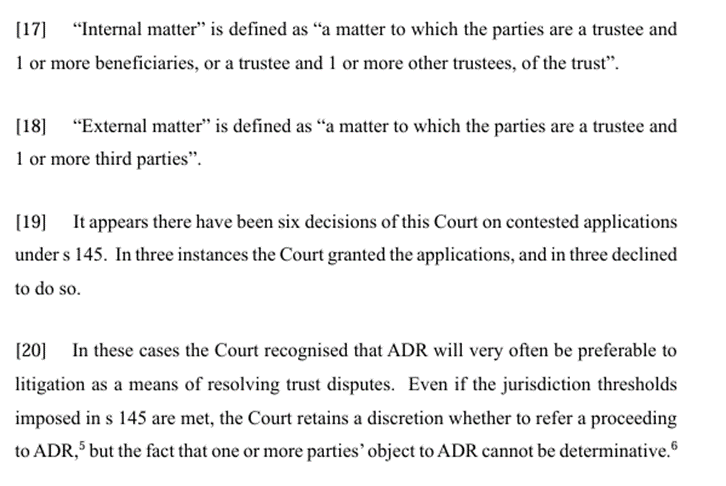
The matter was essentially determined by reference to the fact that the plaintiff was not bringing her claim in her capacity as a beneficiary but as a creditor. As noted by Associate Judge Paulsen at [34]:
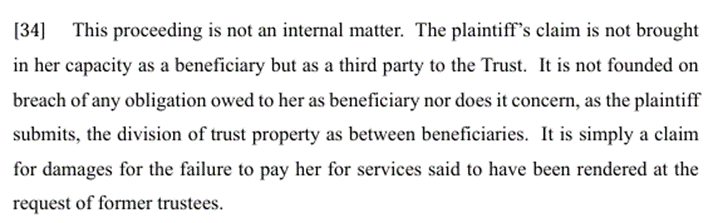
In the event that the court was incorrect in the assessment that the matter was an external matter, consideration was given to whether it would be an appropriate matter for the Court to exercise its discretion to make a referral to mediation. Six grounds were put forward as to why the Court’s discretion should be exercised.
1. Confidentiality
As noted at [41] “… I accept that the possibility of resolving a dispute in a confidential setting is usually a factor in support of mediation, but here the parties have already been through the Family Court proceeding and the resulting judgment is a matter of public record. Very significant damage to the siblings’ relationships has already occurred.”
2. Purpose of the legislation
It was accepted by reference to Gatfield v Hinton that settlement rates of mediation are high and that there are benefits to mediate in most cases.
3. No judicial settlement conference
As set out at [43] and [44]:
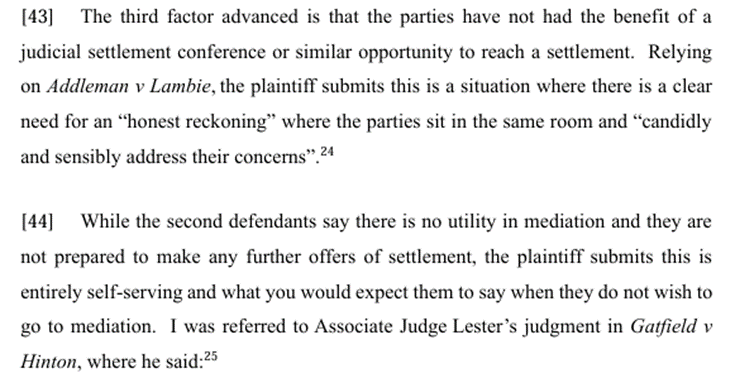

However, in this case the Court did not accept the submission that mediation might result in settlement noting at [48] that “The trustee is taking a neutral position and the suggestion that he might choose to take a different approach at mediation is not realistic.”
4. The issues are clear
This was agreed but was considered a neutral factor.
5. Authority to settle
Associate Judge Paulsen was of the view that this overlooks the fact that one party lived overseas and had advised that health issues would prevent attendance at mediation. As noted at [50] “… The Court would be reluctant to force her attendance even remotely by electronic means in the circumstances she described…”
6. Cost savings
At [51] the potential for cost savings was accepted. However, that “factor must be assessed against the likelihood of settlement and the costs of mediation as compared to litigation in the circumstances of this particular case.”
Memoranda of wishes
As noted in S v N settlor wishes are also a relevant consideration. In the case in hand the Court was of the view that the claim is contrary to settlors’ wishes that their children be treated equally and that the Court should not make an order referring these parties to mediation.
Result
The application under s 145 was dismissed.
References
- Innes v Darlow [2024] NZHC 2614
- S v N [2021] NZHC 2860
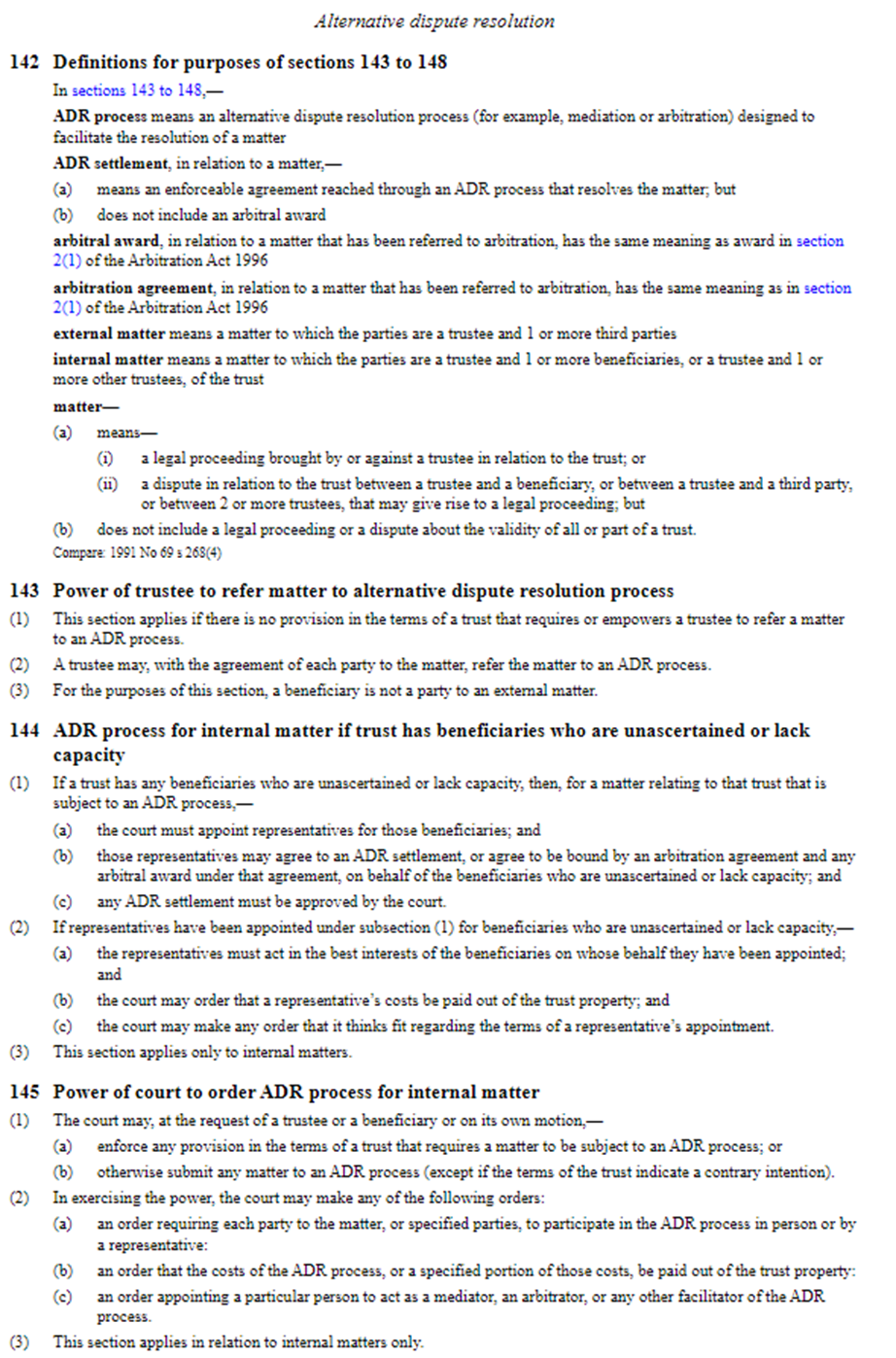
- Trusts Act 2019, sections 142 to 145 (copied below)
- Gatfield v Hinton [2024] NZHC 1712
 Matters of Trust
Discussion
No comments yet.