Settling relationship property matters where this is a trust or trusts in the mix can be problematic where the record of agreement may not correctly reflect trust owned assets. In Willis v Willis, Duffy J was of the view that an agreement that purported to be made under s 21A of the Act could not validly deal with property other than relationship property stating at [31] and [32]:
[31] Section 21D makes it clear that property that may be the subject matter of an agreement under s 21A is relationship property. Further the respondent’s counsel acknowledged to me that the contracting out provisions of the Act, which include ss 21A and 21H, apply to relationship property. While the parties as trustees are registered on the title of the [address deleted] properties and hold legal ownership thereof, they do so on trust for the beneficiaries of those trusts. Insofar as the settlement agreement purports to provide how the [address deleted] properties are to be divided between the parties s 21A could not be used to achieve this outcome. Thus Judge Burns had no jurisdiction to treat the settlement agreement as a s 21A agreement that warranted being given effect to under s 21H.
[32] While the parties may have approached their settlement discussions on the basis they would look through the trusts and treat property they owned as trustees as property available to them for division in terms of their relationship property dispute, this Court cannot ignore the legal character of their ownership of those properties.
The matter is further traversed in Neal v Neal where consent orders were made pursuant to the Court’s jurisdiction under part 18 of the High Court Rules 2016. In that case it was recorded that the parties had agreed “that the settlement extends to all and any claims that the parties and their interests may have against each other now and in the future”. Subsequently the court was required to consider whether the Agreement reached provided for all the transfers to be “relationship property” or in settlement of trust claims or both?
The Court declined to make the directions sought regarding the status of distributions. Dismissing an application for leave to appeal Harvey j noted at [24] that “… While it may be of public interest to resolve the question of whether s 21A agreements under the PRA may be used to settle litigation involving trustee-held assets, that can hardly be answered on an appeal of this case, because as discussed, the
agreement is not a s 21A agreement.”
The takeaway message is to carefully consider the nature of assets and the parties to a settlement when determining the form and content of any agreement or orders that may have a relationship property component or related considerations.
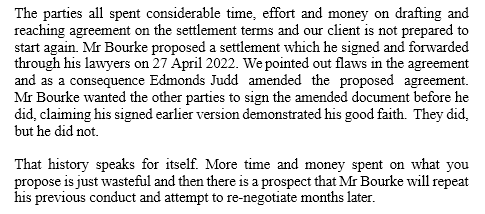
Also see Bourke v Bourke regarding the enforceability of a settlement agreement. As noted at [20] in that case:
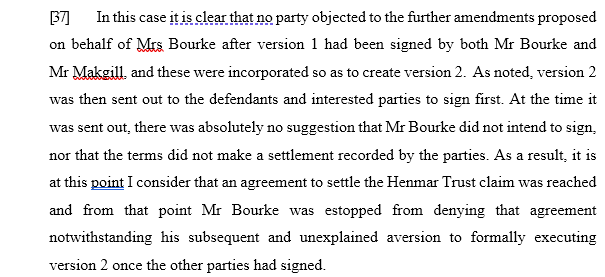
Further, as noted in Bourke v Bourke at [37]:
Importantly, as stated in Fletcher Challenge Energy Ltd v Electricity Corp of New Zealand Ltd at [54]:
“Whether the parties intended to enter into a contract and whether they have succeeded in doing so are questions to be determined objectively. In considering whether the negotiating parties have actually formed a contract, it is permissible to look beyond the words of their “agreement” to the background circumstances from which it arose – the matrix of facts. This can include statements the parties made orally or in writing in the course of their negotiations and drafts of the intended contractual document.”
References:
- Neal v Neal [2024] NZHC 3953
- Willis v Willis [2015] NZHC 2626; [2015] NZFLR 555
- Neal v Neal [2023] NZHC 1280
- High Court rules, part 18
- Bourke v Bourke [2024] NZHC 3218
 Matters of Trust
Discussion
No comments yet.