The genesis of Milne v Sutherland is a dispute regarding the interpretation of a life interest clause.
As noted at [1] “Laurie died in 1999, but the bequests at issue in this proceeding did not fall due for distribution until after the death of his wife, Doreen Rose Evans (Doreen) in 2022…”
As further set out at [4] and [5]:
[4] At the core of the disagreement between the parties is the interpretation of Laurie’s will, and the scope of the life interest he granted Doreen. The defendants say the life interest is an unfettered life interest. They say that the correct interpretation of Laurie’s will is that both the capital and income of Laurie’s estate was held on trust for Doreen’s “free use” during her lifetime. To this end, the trustees were beholden to enable Doreen to enjoy the full benefit of this bequest.
[5] The plaintiffs say that the life interest Laurie granted Doreen entitled her to “free use’ of his money while she was alive, but that any property she bought using that money remained beneficially owned by Laurie’s estate and reverted to his estate on her death.
Laurie’s will provided a life interest for Doreen in the following terms:

The key issue in dispute relates to a bach Doreen purchased after Laurie’s death. The purchase price was largely met from the proceeds of sale of a property in Russell that had been owned by a company that comprised part of Laurie’s estate.
The plaintiffs position is that while Doreen’s life interest in Laurie’s assets gave her “free use” of Laurie’s money while she was alive this did not permit money to be paid to her for the purchase of assets by her.
The defendants’ position is set out at [49] as follows”
“… there is nothing in Laurie’s will to support the assertion that the trustees were not permitted to sell the Russell Property and transfer the proceeds to Doreen, for her to purchase the Omaha Property in her own name. The words of the will provide for all assets to be converted to cash, and for the funds to be held on trust for Doreen to give her the “free use, income, and occupation and enjoyment of” the assets during her lifetime. The only way to have the “free use and enjoyment” of cash is to spend it. Accordingly, the Court cannot imply a term to the effect that the clearly unfettered life interest was subject to a requirement on the trustees to preserve
the estate for the benefit of the residuary beneficiaries.”
While the matter was not determined, the application for summary judgment was unsuccessful Gardiner J stating at [54] and [55] that:
[54] While I understand why the plaintiffs might say that Doreen’s “life interest” means that any property she bought using the cash reverts to Laurie’s estate on her death, this construction has conceptual difficulties. For one, where is the line drawn? It cannot be that any property Doreen bought using cash derived from Laurie’s estate remained beneficially owned by the estate and reverted to it on Doreen’s death. The plaintiffs’ interpretation draws a distinction between types of property which is not drawn in the will or supported by any contextual evidence. Ms Taefi rightfully observed that an amendment to the language of the will would be required to clarify what property should revert back to Laurie’s estate. Furthermore, if the plaintiffs’ interpretation is correct, the Omaha Property should have been held by the defendants as trustees and not Doreen personally.
[55] It is not necessary for me to reach a definitive answer on the correct meaning of the life interest provision. The plaintiffs have applied for summary judgment which requires them to demonstrate that the defendants have no defence to the cause of action. I find by a considerable margin that they have not met this threshold.
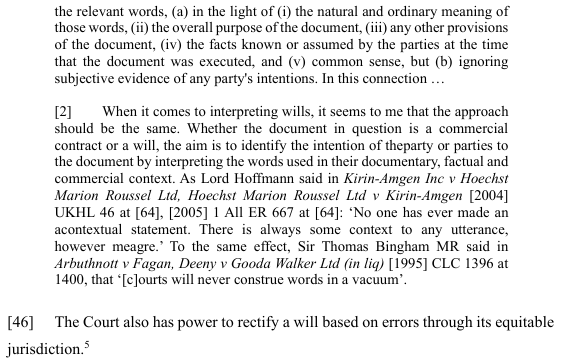
The next step will be an application for a declaration regarding the correct interpretation of Laurie’s will. In this regard the following commentary from [44] to[46] of Milne v Sutherland is illustrative:

References
- Milne v Sutherland [2025] NZHC 1279
- Re Jensen [1992] 2 NZLR 506 (HC) at 510. See Re Walker (dec’d) HC Whanganui M37/99, 21 July 2000 where the Court corrected an error made by the solicitor omitting dispositions to one child of the testator. Extrinsic evidence was provided, including written instructions to the solicitor and a draft version of the will which suggested the child was intended to be included. See also Coleman v Chalklen [2016] NZHC 3178, where the High Court made a rectification order changing the residuary beneficiaries under the will to reflect the testator’s intentions.
- Marley v Rawlings [2014] UKSC 2, [2015] AC 129. Marley v Rawlings has been cited with approval in New Zealand in Bethell v Bethell [2014] NZCA 442, [2015] NZAR 1620 at [38].
 Matters of Trust
Discussion
No comments yet.