The Privy Council Ashley Dawson-Damer v Grampian Trust Company Ltd relates to an application to set aside appointments of trust assets that have the effect of transferring 98% of the trust assets to trusts whose class of discretionary beneficiaries do not include Ashley Dawson-Damer (Ashley). The basis for the application was the proposition that thee was a breach of duty by the trustee on account of “inadequate deliberation.” A further plank of the appeal was the position that the trustee (Grampian) incorrectly identified the settlor’s wishes. As the settlor was a body corporate it is necessary to explore the law on corporate attribution.
Background
George Skelton Yuill, a Scotsman who emigrated to Australia in 1880 died in 1917 having made a large fortune from the production of beef and butter in Australia and the Far East.
Following his death George Skelton Yuill’s substantial estate was administered by four executors. Subsequently “Family Advisers” performed a similar role. Estate funds were settled in Bahamian discretionary trusts. In 1973 a new declaration of trust was made on account of funds held by the Arndilly Trust Company Limited. The discretionary beneficiaries of this trust were two of George Skelton Yuill’s great-grandchildren (George and John), their wives, children and remoter issue. Ashley was the John’s second wife.
1992 Restructuring
In 1992 the 1973 Settlement was restructured to achieve certain tax planning objectives, fresh perpetuity periods, and to create separate settlements for the benefit of John, Ashley, and their adopted children, as well as for George’s family.
The 1992 restructuring involved the trustee, Arndilly, transferring assets worth around US$40 million from the 1973 Settlement to George and John to resettle on new Australian trusts for their respective families. Most of the remaining assets (around US$150 million) of the 1973 Settlement were then transferred to a new company, Spey, which was incorporated in August 1991 in The Bahamas to receive and hold these assets absolutely and beneficially (and not as trustee or in a fiduciary capacity), subject to the objects set out in Spey’s Memorandum of Association.
Spey’s Memorandum of Association was drafted in broad terms and permitted Spey to provide benefits from time to time to all and any of the descendants, including adopted or legitimated descendants, of George Skelton Yuill’s grandson, Viscount Carlow (who had died in the Second World War in 1944 and whose sons were the George and John).
Subsequently Spey transferred the assets it had received as to 25% to the Islay and Annan settlements for George and his family; 25% to the Willards settlement for John and his family and 50% to the Glenfinnan Settlement. The beneficiaries of the Glenfinnan settlement were the same as the 1973 settlement.
Grampian was the trustee of each of the four new settlements.
In September 1992 Mr Stanford-Tuck prepared “The Yuill Trusts: Explanatory Memorandum and Diagrams (For the use of Trustees and Trust Advisers)” to set out the history of the family and the various settlements. The 1992 Memorandum stated that the 1992 restructuring was intended “to make a fixed and final division of the trust assets between the two families”. Under the heading “The Current Structure” the 1992 Memorandum says with respect to Glenfinnan, that these trusts are “Discretionary for the benefit of George and John and their families (excluding adopted children)”. It also says: “Objects–Long term accumulating trust for the benefit of next generation beneficiaries”. It states that all decisions of the various trust and holding companies are taken by directors who are assisted by the Family Advisers. The latter’s functions include keeping in close touch with the beneficiaries and advising the trustees of their interests and aspirations.
Whose wishes?
In 1992, Mr Johnstone received a copy of the 1992 Memorandum. There is no evidence that the other two directors of Spey at the time (Mr Lobosky and Mr Lowe) ever received, read, or knew about it. It is Grampian’s case that the 1992 Memorandum accurately set out what Spey’s wishes and intentions were, as settlor, when it transferred the assets to Grampian under the Glenfinnan Settlement. Mr Stanford-Tuck understood that the reference in the 1992 Memorandum as regards the Glenfinnan Settlement to the “next generation beneficiaries” was to those beneficiaries of the 1973 Settlement other than George, John and their wives. Mr Stanford-Tuck accepted in his evidence at trial that, when he prepared the 1992 Memorandum, he was not acting on behalf of Spey and it is now common ground between the parties that the 1992 Memorandum is not a document that can properly be attributed to Spey.
Family relationships
Tragically, Ashley’s husband, John, died in a motor-racing accident in 2000. Following John’s death, relations between the Family Advisers and Ashley soured and ultimately became strained and acrimonious.
Assets held in the Willards Settlement were moved out of the trust of which Grampian was a trustee.
On 3 July 2003, Grampian adopted a resolution that no distributions of capital or income should be made from the Glenfinnan Settlement for the time being except in the event of changed circumstances and unforeseen contingencies “and that the income of the trust assets should be accumulated for the future benefit of the next generation of beneficiaries, meaning George’s natural children, grandchildren and remoter issue and their wives and widows.”
98% of the Glenfinnan settlement is dissipated
In 2006 Grampian moved 60% of the assets in the Glenfinnan Settlement to new discretionary trusts. The decision was somewhat contentious. The new discretionary trusts were all for the benefit of George’s children and his descendants.
In 2009, a further appointment of the remaining Glenfinnan Settlement assets was made for the benefit of George’s children (the Moray Settlement). Grampian was the trustee of the Moray Settlement.
Following the 2006 and 2009 appointments 2% of the assets of the Glenfinnan Settlement remained (valued at US$6.6 million at the time and US$14 million by 2025). The effect of moving the other 98% out of the Glenfinnan Settlement precluded any further appointments from those assets either to Ashley or, by way of a Pilkington advance, to her children.
The proceedings
The main issues in the courts (the matter was heard in the Supreme Court (Bahamas), the Court of Appeal Bahamas and then on appeal to the Privy Council) have focused on the justification for the 2006 and 2009 appointments. Ashley’s case has been that Grampian had followed a policy of excluding her and her children as beneficiaries because the directors of Grampian and the Family Advisers were very hostile towards her. Ashley also argued that Grampian had failed to adequately consider her position and, in particular, that Grampian’s directors had failed to ensure that they had up-to-date information about her financial and other circumstances.
Grampian’s case has been that in making the appointments it was fulfilling the settlor’s wishes and that although Ashley had been a beneficiary of the Glenfinnan Settlement, that trust’s assets were to be accumulated for future generations.
With respect to settlor wishes, as noted in the Supreme Court decision at [60] and [63]:


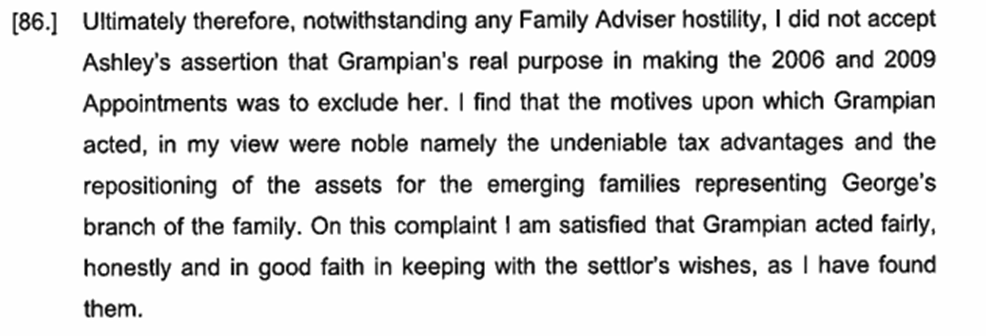
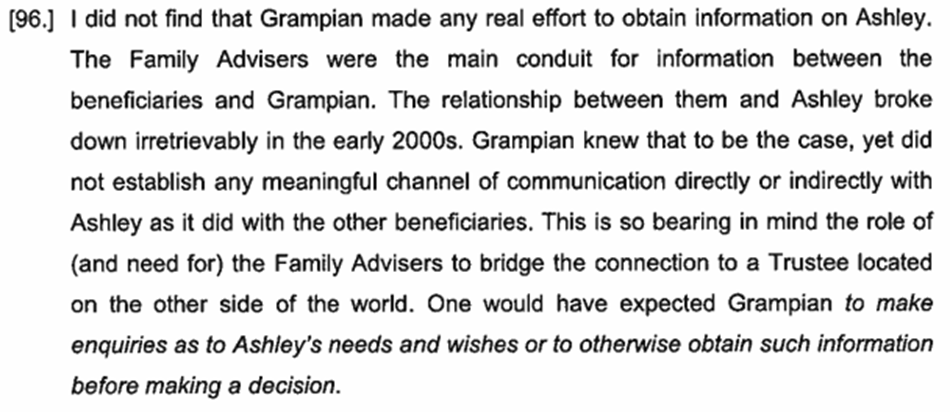
With respect to Grampian’s purposes as set out in the Supreme Court at [86] and [96]:
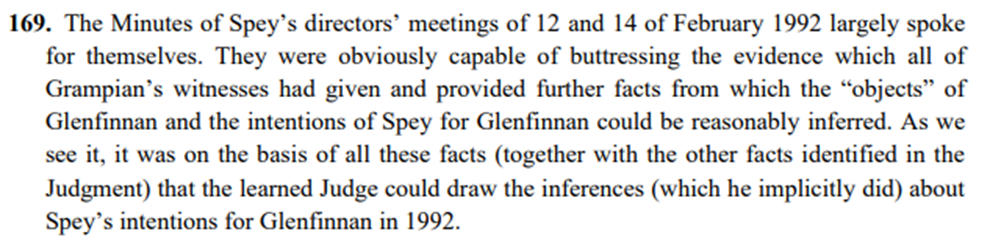
On appeal the Court of Appeal noted at [293] and [169] that:

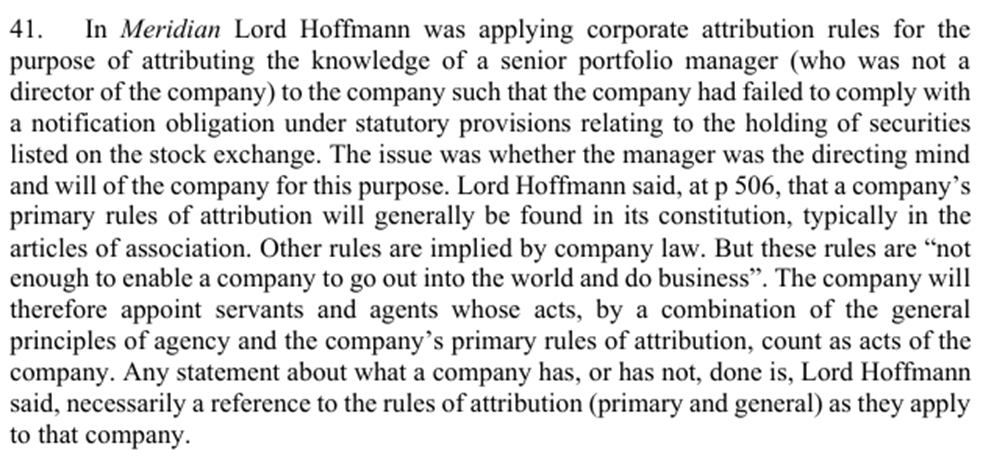
The Privy Council, which up-held the decisions of the lower courts, but with some clarification made the following observations regarding corporate attribution at [41]:
At [53] the Board stated that it “… is fully satisfied that when Winder J referred to “Spey’s intention” he was using that as shorthand for saying the intention (ie the wish and intention) of all (or a majority) of the board of directors of Spey. It follows from the reasons we have given that, in the Board’s view, the judge was entitled to make that finding and he was applying the correct legal test of corporate attribution.”
With respect to inadequate deliberation as set out at [74]:
“… Once one accepts (as the Board has on Issue 1) that the wishes and intentions of Spey were that this trust was primarily for the benefit of the next generation, it is clear that Ashley cannot show that the decision would have been, or even might have been, different had there been no breach of fiduciary duty. Contrary to the advice of the Family Advisers, the trustee did provide for the needs of Ashley by holding back 2% (now worth some US$14 million) in the trust fund as a safety net for her. She was a very wealthy woman with funds from other sources, including the estate of her late husband John and, even though there was a breach of the fiduciary duty of proper consideration, Ashley cannot show that the trustee, or a reasonable trustee, would have acted, or even might have acted, any differently had there been no such breach.”
Vicki Ammundsen is presenting a webinar on Memoranda of Wishes on 6 August 2025. For more information see https://www.cchlearning.co.nz/events/4644-trust-series-2025-memoranda-of-wishes/
Also see
References
- Ashley Dawson-Damer v Grampian Trust Company Limited [2025] UKPC 32
- Ashley Dawson-Dalmer v Grampian Trust Company Limited 2015/CLE/gen/00341
- Ashley Dawson-Dalmer v Grampian Trust Company Ltd SC Civ App. No. 30 of 2022
 Matters of Trust
Discussion
No comments yet.