It is common for appointment as a final beneficiary to be considered a higher ranking appointment than a disretionary beneficiary.
However, what does it really mean to be a final beneficiary? Fundamentally, this might often be no more than the right to receive all or part of the remaining trust assets (if any) when the trust comes to an end. Importantly, there may be powers that can be exercised (other than discretionary powers to distribute income or capital) that might frustrate such expectations. The effluxion of time is another serious consideration where a trust’s maximum duration will likely exceed the lifetime of final beneficiaries identified by name or class.
In Barrett v Osborne the settlor, who was also a trustee, made an appointment of the entirety of the trust fund to one daughter. The power relied upon was in the following terms:
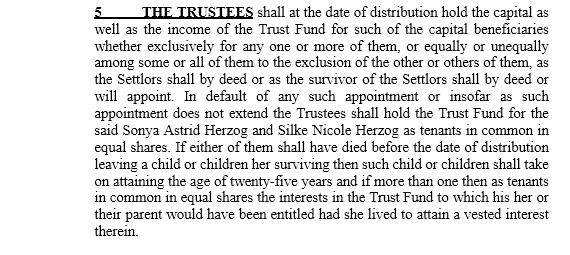
As noted by Lang J at [20]:
“The issue for present purposes is whether, in exercising the power given to the settlors under cl 5 of the deed of trust, Lothar owed any fiduciary duty to the capital beneficiaries. Silke contends this issue must be answered in the negative. She says that in exercising this power Lothar was not subject to any fiduciary duty to the capital beneficiaries. Sonja argues to the contrary. She contends that the settlors, or the survivor of them, owed a fiduciary duty to the capital beneficiaries when exercising the power under cl 5.”
Relevantly, as noted at [22]:
“Lothar did not have the power to appoint himself to receive the trust assets as was the case in Clayton. This meant he clearly owed a fiduciary duty to the capital beneficiaries not to deal with trust assets in a manner that was contrary to their interests or that advanced his own interests at the expense of theirs. However, he had the unfettered power to nominate which of his two daughters and/or their children should receive the trust assets and in what proportion.”
While the Court was sensitive to Sonja’s vulnerability to her father’s actions, as noted at [27] this “… vulnerability did not arise from the particular nature of the relationship between Lothar and Sonja as will usually be the case where fiduciary duties are imposed. Rather, it arose from the nature of the power given to Lothar under cl 5 of the trust deed.”
Accordingly, the terms of the trust meant that once there was a valid exercise of the power of appointment, the trustees were bound to give effect to that appointment. Had the trustees not done so, they would have been in breach of their duties as trustees to act in accordance with the terms of the trust.
Vicki Ammundsen is presenting a webinar on trustee liability, which includes consideration of trustee obligations with respect to final beneficiaries.
References:
- Barratt v Osborne [2024] NZHC 1733
 Matters of Trust
Discussion
No comments yet.