Section 118 of the Trusts Act 2019, which provides that persons who become trustees may complete any formal requirements necessary for the divesting and vesting of trust property on behalf of a former trustee who loses capacity to perform the functions of a trustee, fails or refuses to assist in any transfer. However, where a sole trustee dies section 118 is not available and a vesting order will be required.
As noted in Public Trust (In the Matter of the M Arnott Trust) at [10] and [11] where the sole trustee had died:
[10] The circumstances of this case bear strong resemblance to those in Re Kominik, which concerned an application for vesting the trust property in the new trustees of the trust, following the death of the former sole trustee.4 In that decision, McHerron J confirmed that ss 116 and 117 of the Trusts Act permitted the making of a vesting order in the new trustees where the prior trustee had died. He noted the “execution of the document of appointment” in that case was the death of the former trustee, which brought the will into effect, under which the new trustees were appointed. Similarly, in this case, Ms Arnott’s passing resulted in certain clauses of the Trust Deed coming into effect, which automatically appointed the Public Trust as the sole trustee.
[11] I am therefore satisfied that, in accordance s 116(1), a new trustee of a trust has been appointed, and a trustee of the trust has been removed, through the death of the previous sole trustee, triggering the clause in the Trust Deed that appointed the Public Trust as the replacement trustee. Therefore, under s 116(2), the execution of the document of appointment, removal or discharge, namely the Trust Deed, has divested the trust property from Ms Arnott and vested the property in the Public Trust. Accordingly, under s 117(b) of the Trust Act, the Public Trust has a right, as the new trustees of the Trust, to call for the transfer of the trust property to itself.
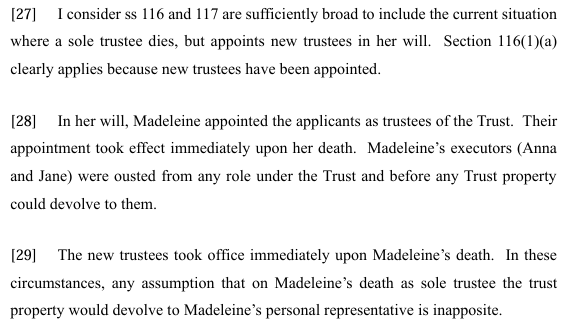
The circumstances addressed in Re Kominik Family Trust and the Arnott Trust arise because the death of the sole trustee had the effect of triggering the appointment of a pre-determined trustee. No power is exercised to change the trustee, as instead the death itself triggered the appointment. Where that is the case, the court view appears to be that s 102 is ousted. See Re Kominik Family Trust at [27] to [29]:
Editor’s note
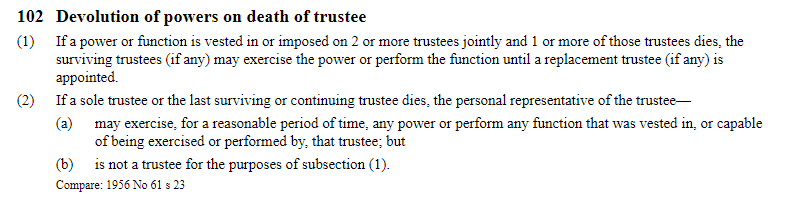
This is different to the position where a sole trustee dies and the death does not trigger the appointment of a new trustee. In this case section 102 of the Trusts Act 2019 may have application:
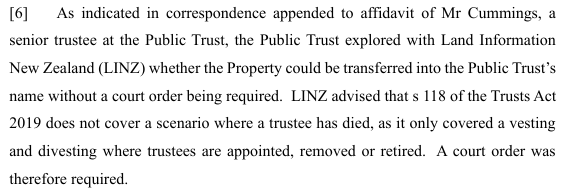
In Arnott no power is exercised, as the death itself triggered the appointment – rather than a subsequent exercise of a power. For these reasons the Court was of the view is that section 118 does not apply, see Arnott Trust at [6] and [9]:
…

It is noted that section 118 does not reference the death of a trustee.
It may be that the court is making a distinction between an existing appointment being triggered (in which case s 102 is ousted and a vesting order is required), and an appointment being made following death (in which case s 102 is not ousted and the executor of the deceased sole trustee can accept the transmission and then transfer to a newly appointed trustee or trustees).
References:
- Public Trust (In the Matter of the M Arnott Trust) [2025] NZHC 1249
- Trusts Act 2019, s 116, s117 and s 118
- Re Kominik Family Trust [2024] NZHC 1028
- Trustee Act 1956, s 23 (repealed)
 Matters of Trust
Discussion
No comments yet.