The Court of Appeal decision in Gatfield v Hinton represents an important waypoint regarding the ADR provisions of the Trusts Act 2019. The decision traverses a range of matters including:
- whether ADR can be sought by way of an interlocutory application where there are existing proceedings on foot (the answer is yes)
- the authority of an Associate Judge to order ADR (again the Court of Appeal determined in the affirmative)
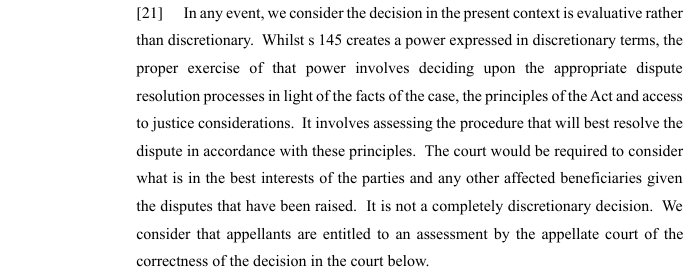
- whether a decision under section 145 of the Trusts Act involves the exercise of discretion or an evaluative assessment – this has procedural ramifications as if the assessment is evaluative, the appellant must identify an error that must be determined by the appellate court on the merits. Relevantly, as noted at [20] “A discretion will exist where there is more than one decision open to the decision-maker as a matter of law. That does not arise simply because the statute expresses the power in discretionary terms through the use of words such as “may.”…” On this point the Court of Appeal states at [21] that:
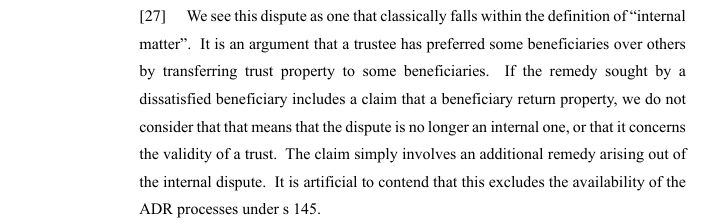
ADR can only be ordered in respect of internal matters that do not relate to the validity of all or part of a trust. In the appeal the appellants argued that the dispute concerned new arrangements in relation to the property in question that were additional to, and very different from the trusts established under Mr Gatfield’s will. In this regarding the Court of Appeal stated as follows at [27]:
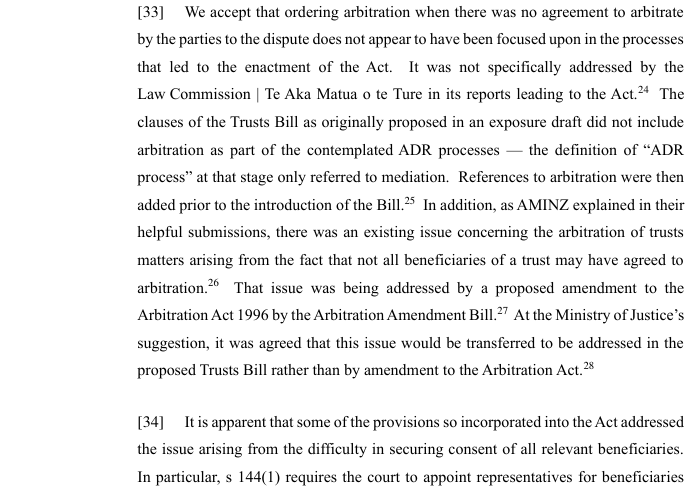
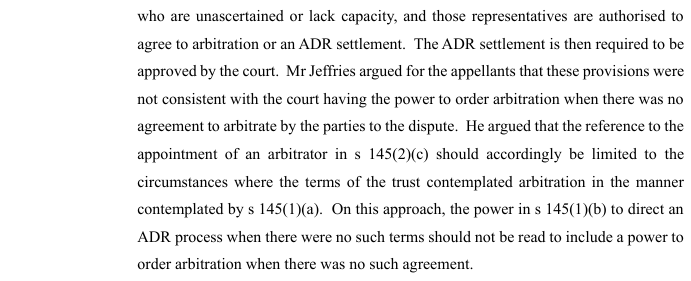
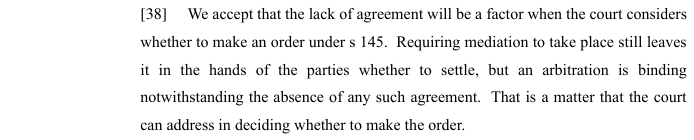
The appeal also traversed whether an order can be made pursuant to section 145 of the Trusts Act in the absence of an agreement to arbitrate. This is traversed at [33] to [34] in the following terms:
Further as noted at [38]:
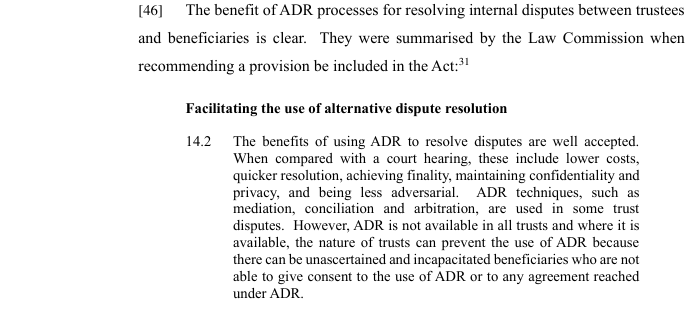
With respect to the benefit of ADR as noted at [46]:
When considering the practical aspects of ADR the Court of Appeal traverses the core of the dispute in the following terms at [47]:
“… It is not a dispute based on financial matters, but on feelings associated with the personal history at the bach, described as a family taonga. It also involves strongly felt personal allegations. When there is a highly emotive family dispute of this kind, the deployment of confidential processes has real advantages. The use of an experienced mediator seeking to find a way through the
disputes with the parties is obviously beneficial, and if such a mediation fails (as it has), it is also appropriate to have an adjudicative process in a private environment, where the sometimes acrimonious disputes can be properly addressed without the
glare of publicity that would likely accompany this proceeding if it proceeded before the Court. The parties will have greater control of the timing and speed of the adjudication, and the decision is more likely to be a final one. It will also assist in
resolving the disputes in a manner that avoids unnecessary cost and complexity, consistently with ss 3(c) and 4 of the Act.”
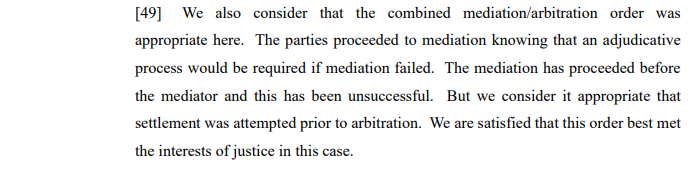
In ordering arbitration, the final word is summarised at [49] in the following terms, which may well be the harbinger of trust disputes moving forward:
Fundamentally, given that court proceedings result in a decision by a judge or judges, some pause is required to assess the challenge to an arbitrator authororised to determine an outcome in the same proceedings. In the alternative, following Gatfield v Hinton is it that filing proceedings under the Trusts Act 2019 that relate to an internal matter can be equated to an agreement to submit to arbitration?
For further background to Gatfield v Hinton see New is not a reason not to.
References
- Gatfield v Hinton [2026] NZCA 17
- Trusts Act 2019, s 145
- Gatfield v Hinton [2024] NZHC 1712
- S v N [2021] NZHC 2860 [2021] NZFLR 756
- Wright v Pitfield [2022] NZHC 385
- Terry v Terry [2023] NZHC 884, (2023) 6 NZTR 33-019
- Boult v Crux Publishing Ltd [2022] NZCA 473
- Lawyers and Conveyancers Act (Lawyers: Conduct and Client Care) Rules 2008, r 13.4
- Gatfield v Hinton [2024] NZHC 2603
 Matters of Trust
Discussion
No comments yet.