Vincent v Vincent Family corproate Trust Limited concerns a dispute regarding who should benefit from two family trusts in circumstances where the Court is asked whether whether whāngai children shoud be included in the class of grandchildren. As noted at [7] to [10]:
[7] The Trusts distinguish between income and capital beneficiaries. Only capital beneficiaries share in the final appropriation or distributions. The capital beneficiaries include named grandchildren of the Settlors, all grandchildren born before 24 June 2020, and all great grandchildren of the Settlors born to Theresa Hinemoa Vincent (Theresa) before 24 June 2020. Notably, Theresa was the Settlors’ biological granddaughter but had been raised as their daughter.
[8] Not all of the named “grandchildren” are biologically related to the Settlors. As mentioned, Manuka was adopted by Tom but still named as an income beneficiary. Manuka then adopted his brother-in-law’s child, Shane Clifford Vincent, as a whāngai around 1976. Shane is named as a “grandchild” of the Settlors in the trust deeds and as an income and capital beneficiary.
[9]In summary, the undisputed beneficiaries of the Trusts include:
(a) the Settlors’ eight children by birth, named as income beneficiaries;
(b) Manuka, expressly named as an income beneficiary
(c) 30 grandchildren by birth, who are all income and capital beneficiaries
(d)Shane, named as an income and capital beneficiary; and
(e) two great-grandchildren born to Theresa (SD and KC) who are income and capital beneficiaries.
[10] At one point, the trust funds comprised property totalling approximately $14.5–16 million, with the property of the P Vincent Trust also including Māori land. Following the date of final appropriation on 24 June 2020, the Trusts’ commercial properties were sold and interim distributions were made to the capital beneficiaries. Each capital beneficiary’s share was approximately $450,000 and the majority of this was distributed. As of April 2025, the only remaining trust assets were $1.2 million in cash and a conservative estimate of $3 million from the sale of the one remaining unsold property. Following distribution of these remaining amounts, the Trusts will be wound up.
The matter ultimately settled . However, as this resulted in a variation to the terms of the trusts, court consent was required. as noted at [16]:
[16] The court has jurisdiction to endorse and approve this settlement, and to vary the Trusts, pursuant to its inherent and supervisory jurisdiction over estates and trusts. This jurisdiction is guided and supplemented by the relevant provisions of the Trusts Act 2019. The principles in relation to s 124 outlined by Mander J in Gavin v Gavin appear particularly relevant, and I especially note:
The court’s discretion is to be exercised with reference to the factors identified in s 124(4), including the intentions of the settlor, to the extent these can be ascertained.

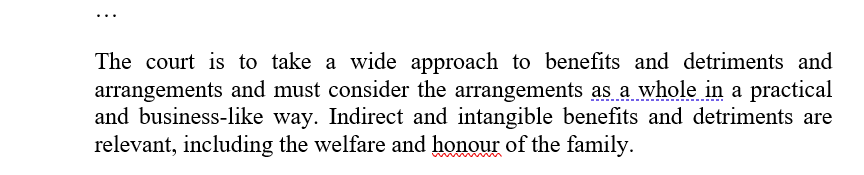
As further noted at [17] to [19]:
[17]Taking into account all relevant circumstances — including the history of the proceedings, the prospects of further delay and costs through continuing litigation and any subsequent appeals, and the ongoing impact of delay on the parties and their respective personal, business and financial interests — I agree that a negotiated settlement is strongly preferable.
[18] I have carefully examined the content of the proposed settlement. I further note that the parties have had the benefit of legal advice throughout the proceedings over the last five years.
[19] In addition, I am familiar with the evidence and submissions put before the Court and on the issues argued before me during the hearing. Overall, I am satisfied that what is proposed and the orders sought provide, in broad terms, for a just and proper settlement between the parties. It represents a sensible compromise that takes account of a range of relevant considerations, including, above all, the intention of the Settlors. That the settlement essentially respects their wishes is testament to the parties’ pragmatic approach to the issues and the need for certainty and closure to what has been a very challenging process for all involved. In summary, I see no reason, therefore, why the orders sought should not now be made.
References:
- Vincent v Vincent Family corproate Trust Limited [2025] NZHC 2068
- Gavin v Gavin [2021] NZHC 550
- Re Setter [2021] NZHC 1603
- Ruby v Ruby [2022] NZHC 282.
 Matters of Trust
I ran into this quite a number of years ago. A Māori couple appeared before me. They had a dispute with a woman. Despite them adopting European technical language to describe the relationship with the other woman, there was something peculiar in the messages and emails.
The man was communicating with his niece as a peer, rather than as an uncle might communicate with a niece. There was nothing untoward about it, but it was just noticeable and I couldn’t understand it.
I was alert enough to ask them if there was something about the kinship system that I didn’t understand. I was told about this custom amongst iwi around Lake Taupo. Perhaps it is more widespread.
I was able to throw in some te reo Māori as we discussed the dispute, and gain some trust and buy-in. If you’ve got it, you should use it. If you don’t have it, you should be open to it.
Posted by David Marks KC | March 18, 2026, 10:44 am