McKean Family Trustee Limited v McKean (No 2) relates to an interlocutory judgment regarding whether the Trustee’s costs to defend removal proceedings and for proceedings seeking amongst other things a direction for the sale of a trust owned farm should be met from the Torwood Family Trust (the Trust).
The background is set out at [4] in the judgment as follows:


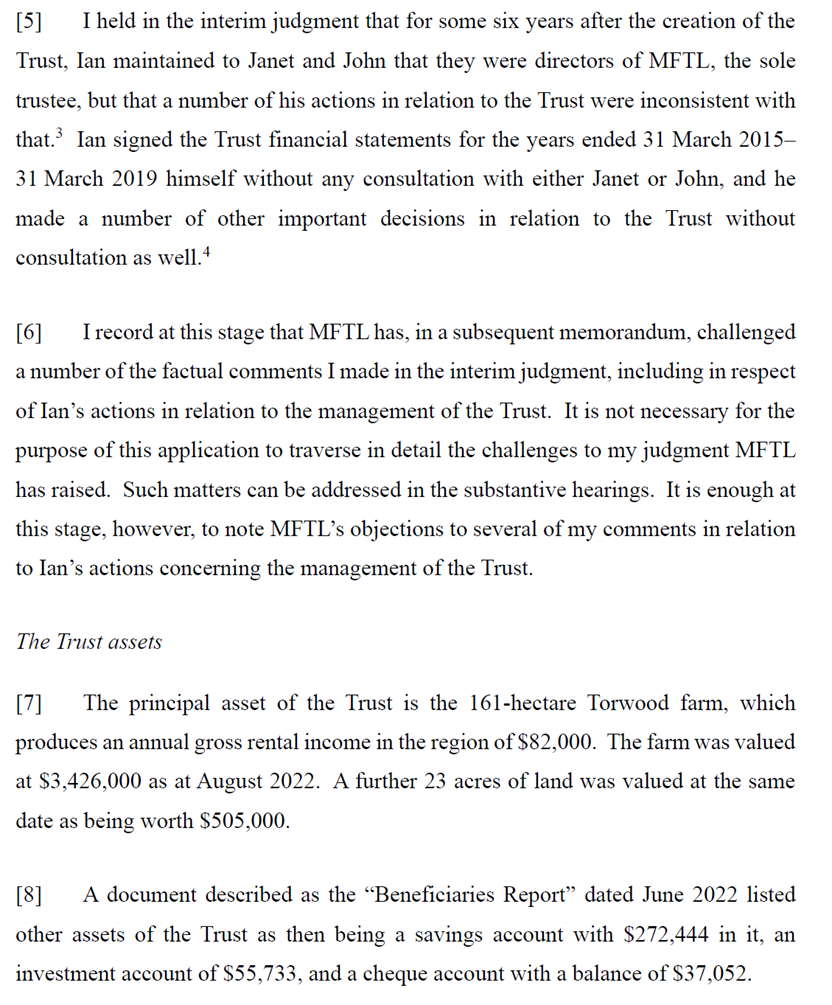
As set out at [5] to [7]:
The relevant legal principles are set out at [38] to [42] and [44] to [46] as follows:


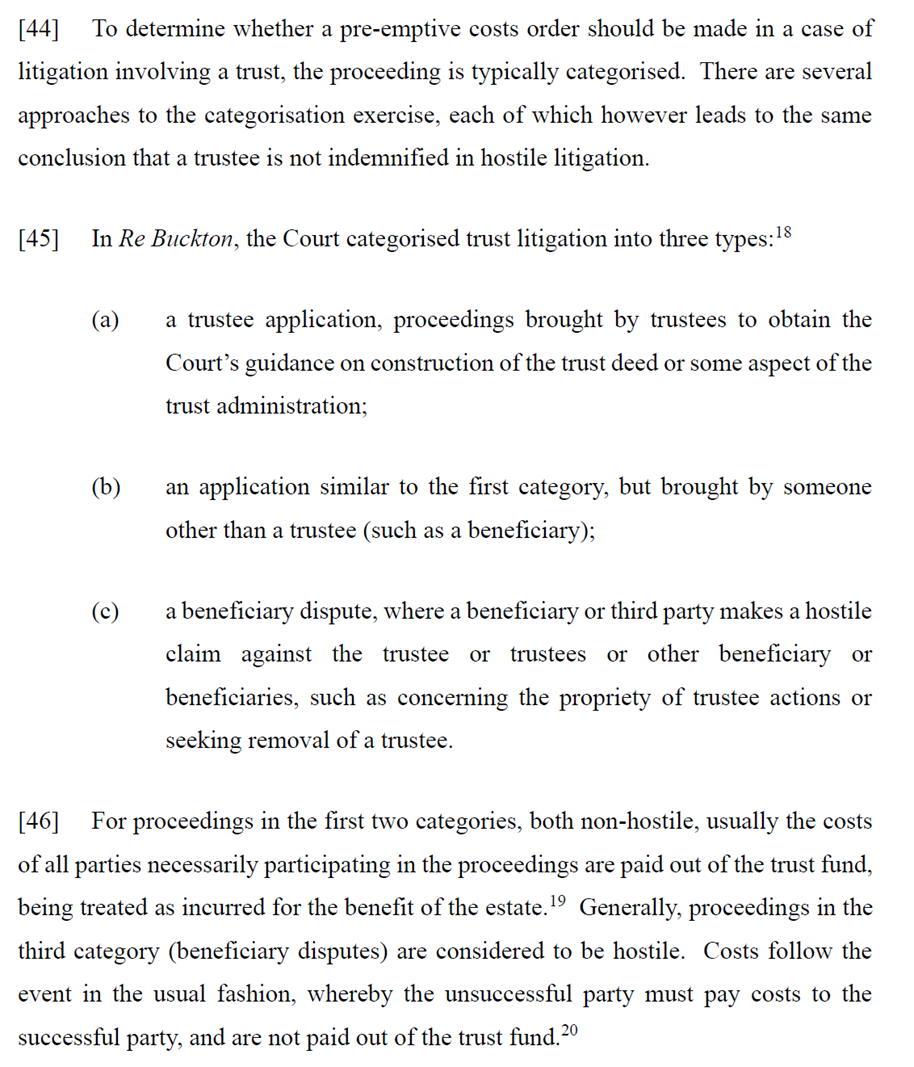
There are alternative classifications such as in Lewin on Trusts, which identifies seven broad categories of trust proceedings and the Alsop categories (as set out in Alsop Wilkinson (a firm) v Neary).
Regardless of the classification relied, trustees who are party to hostile litigation cannot expect to rely on any indemnity available under the Trusts Act 2019 or the terms of the trust. As stated by the Court of Appeal in McCallum Jnr v McCallum at [32]
… It would be difficult to imagine a truly hostile proceeding, involving an allegation of breach of trust with at least some prospect of success, where it would be in the best interests of the trust to pre-emptively indemnify the trustees for costs out of the trust assets before determining those allegations.
Trustees can lose rights of indemnity, without there being hostility, if the trustee’s costs are unreasonable or not properly incurred. As noted by Hammond J in Re O’Donoghue at [27]
… it is the beneficiaries who are meeting the trustee’s expenses. It follows that it is critical that there be a check on those expenses and costs incurred by a trustee … it is only expenses which are “properly incurred” which are the subject of a trustee’s indemnity …
The position in McKean is set out at [58] to [61] as follows:
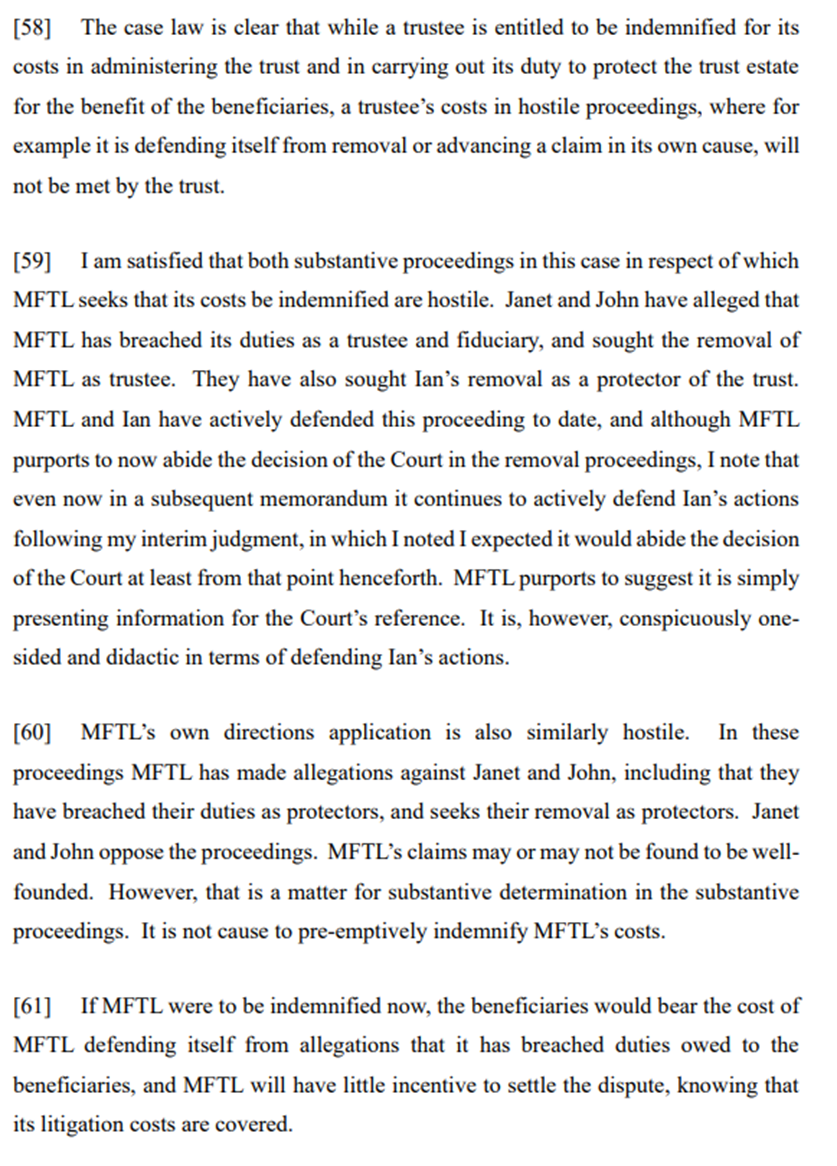
The result for the trustee in McKean is that the trustee is denied any indemnity pending the ultimate outcome of the substantive proceedings. The decision is a timely reminder that trustees act not for themselves but the beneficiaries and rights of indemnity can be lost where a trustee does not act properly.
Also see Tadd Management Limited v Weine, which considers trustee’s limitation of liability for professional trustees.
References:
- McKean Family Trustee Limited v McKean (No 2) [2023] NZHC 1098
- Alexander v Alexander [2021] NZHC 3056
- McCallum Jnr v McCallum [2021] NZCA 237
- Alsop Wilkinson (a firm) v Neary [1996] 1 WLR 1220 (Ch)
- Lynton Tucker, Nicholas Le Poidevin and James Brightwell Lewin on Trusts (20th ed, Sweet & Maxwell, London, 2020) [Lewin on Trusts] vol I at [19-007] and vol II at [48-004]
- Re O’Donoghue [1998] 1 NZLR 116
- Tadd Management Limited v Weine [2023] NZHC 764 at [260] to [274]
 Matters of Trust
How does the perspective of indemnity as a privilege impact the obligations and responsibilities of the parties involved?
Posted by PTS Terbaik Indonesia | June 19, 2023, 10:31 pmThat will depend in large part on the nature of the obligations and who the parties are.
Posted by vickiammundsen | November 11, 2023, 4:19 pm