Worksafe New Zealand MHI Haumaru Aotearoa v RH & Jury Trust & Ors (Worksafe v Jury) relates to a tragic and fatal accident where a young child visiting his grandfather at work on a dairy farm died after his jacket was caught in an exposed rotating shaft.
As noted at [4]:

Fundamentally, Worksafe v Jury relates to “what is a trust?” from a charging perspective where parties are to be brought to account.
As noted at [6]:
“… In Worksafe’s view this was a situation where liability was more properly placed on the
trust because it was conducting business and the failures were systemic failures of
governance and management, rather than personal failures by the trustees.”
Harvey J went on to consider the legislative regime that relates to workplace safety noting at [12] to [14] that:

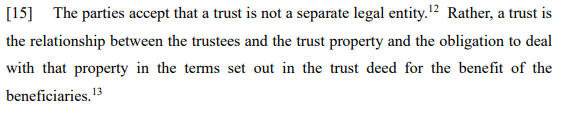
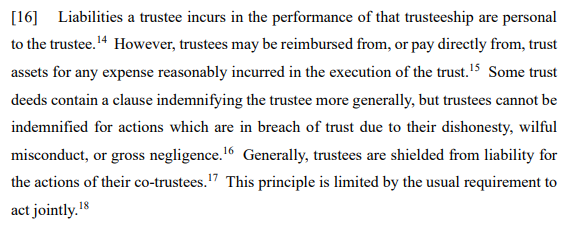
With respect to the “orthodox” trust position, as set out at [15] and [16]:
In the District Court decision, which is the subject of this appeal, it was noted that “In some cases prosecuting trusts rather than trustees will better reflect culpability in light of trustee duties and collective decision-making roles. This would be consistent with how the Act treats company directors.”
The practical import of this is the penalty regime that can be imposed on individual trustees compared with trustees as a body of persons.
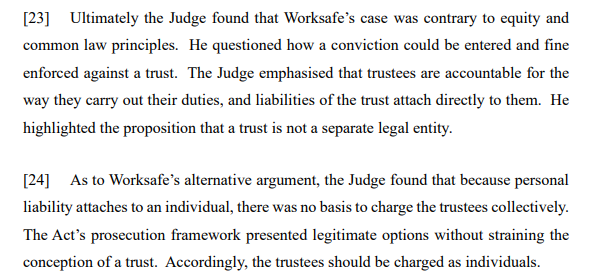
By way of further background, as noted at [23] to [26]:

Importantly, as noted at [39]:

and at [42] to [43]:
” … Given the widespread and well-known use of trusts in business in New Zealand, it could be expected that Parliament would have expressly included trusts in the definition as it has done in the other legislation. On the other hand, Parliament did not include trustees or trusts in the exclusions set out in s 17(1)(b). In a sense the Act is unhelpfully silent on the issue.
[43] Nonetheless, the interpretation to be preferred is that the trustees collectively are the “body of persons … unincorporate” rather than the trust itself. In civil law, generally, liabilities accrue to the trustees…”
Accordingly:

The question remains as to what the position would be where a trust had a single trustee. Given the importance of workplace safety, the failure of the relevant legislation to specifically address trust ownership is fundamentally unsatisfactory.
References
- Worksafe New Zealand MHI Haumaru Aoteaoa v RH & Jury Trust & Ors [2023] NZHC 3871
- WorkSafe New Zealand v Kellisa Farms Ltd [2022] NZDC 2490
 Matters of Trust
Discussion
No comments yet.