In the anonymised High Court decision Smith v Koppens [2026] NZHC 759 a constructive trust is imposed by reference to the principles of Lankow v Rose on account of advances made by “Jane” who had expected to live in a trust owned property.
By way of background the dispute arose in circumstances where a mother made advances to her son, and later his trust. For a time the mother (Jane) lived in the property, and expected to remain doing so. However, as set out at [1]:”…Jacob accepts he owes his mother money but disputes the amount owed and says that while he was happy for his mother to live in the property, he never
intended that she would own half of it.”
One loan of $100,000 was recorded by way of a statutory declaration confirming that the $100,000 was not a loan. Another advance of $214,547 was to repay borrowings secured against the property that Jane moved into. In addition to these amounts Jane transferred $170,000 to Jacob as an “early inheritance” and also paid for improvements on “her” share of the property.
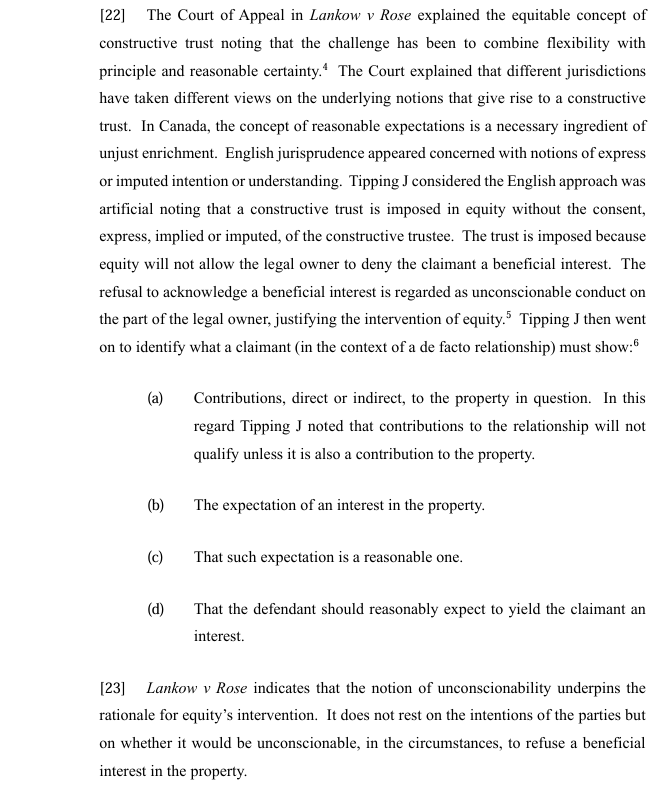
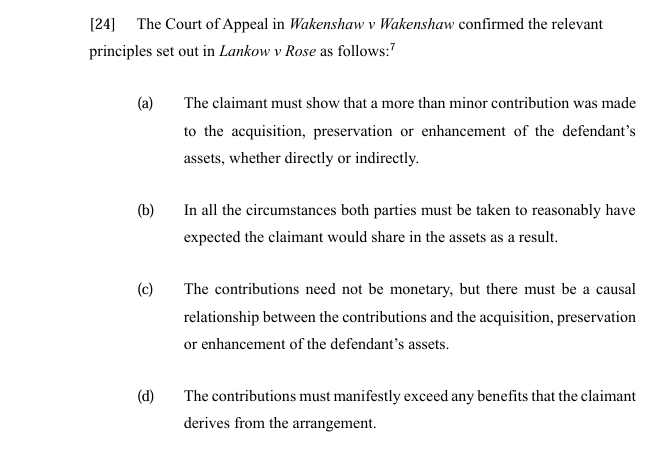
The relevant law is set out at [22] and [24] as follows:
Notwithstanding that the $100,000 advance was recorded as not being repayable in a statutory declaration, the court accepted that it was understood that Jacob would repay this advance.
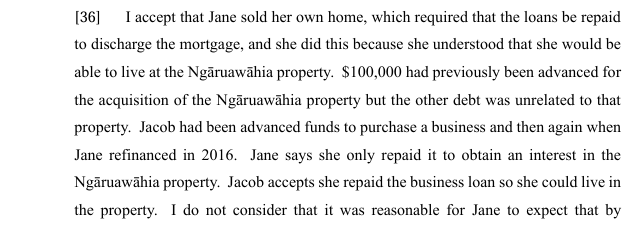
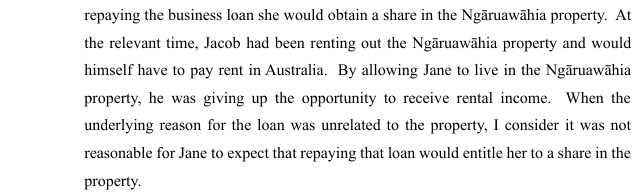
The Court carefully considered the application of each loan. As noted at [36]:
The evidence around what was intended was conflicting. However, as noted at [45] “… I consider that Jane
was content not to be on the title. She came across as smart and competent, but the evidence also indicates that she was comfortable with signing a statutory declaration that was not true…”
Ultimately the Court was satisfied that the $100,000 advance was applied to the property. The Court was also ultimately satisfied that payments Jane made to reduce Jacob’s borrowings were “…advanced to assist with repaying the mortgage secured against the
[ ] property and that it was reasonable for Jane to expect she would have an interest in the property because she understood she could live there for her life.”
The Court recognised that more significant expenditure on improvements was not appropriately accounted for as rental.
Constructive Trust
As noted at [66] to [68]:
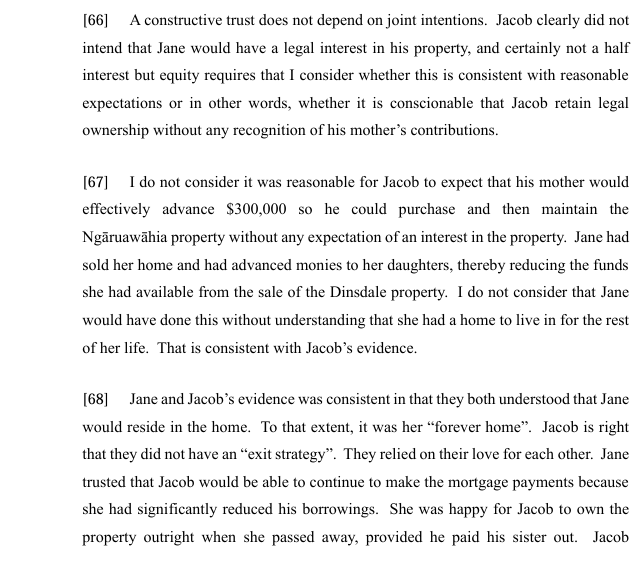

Jacob was prepared to yield an interest in the property, but not the 50% share Jane sought.
As set out at [74] to [76]:
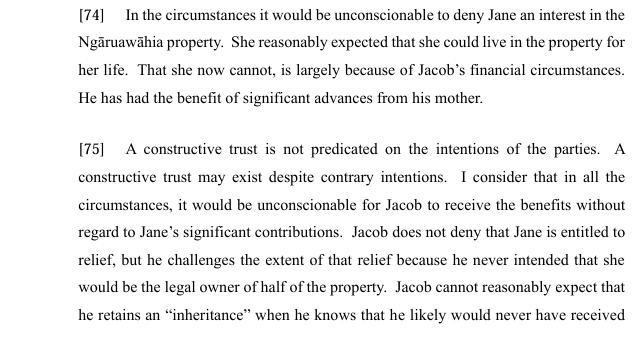
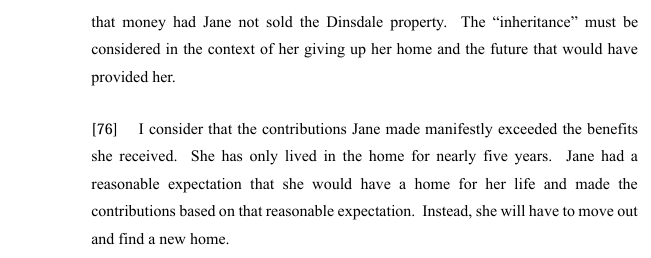
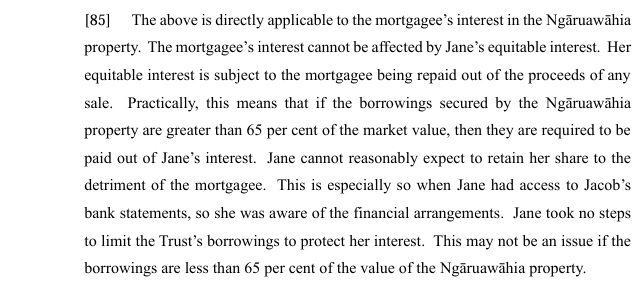
The Court considered a 35% interest was appropriate. However, this is subject to the borrowings secured against the property, meaning that the effective interest held on constructive trust for Jane may be reduced. This is explained at [85] as follows:
References:
- Smith v Koppens [2026] NZHC 759
- Lankow v Rose [1995] 1 NZLR 277
- Wakenshaw v Wakenshaw [2017] NZCA 252, [2018] NZAR 532


Discussion
No comments yet.