In Baker v Humphreys Mr Baker sought orders confirming his appointment as sole trustee and vesting trust property in him. The background details need consideration to put the application into context. These are summarised as:
- Sheila and Kim (the Trustees) were the original trustees of a trust
- Sheila had the power to appoint new trustees
- The Trustees owned 1/3 of a property
- Sheila subsequently developed dementia and Mr Baker was appointed as her property manager pursuant to section 31 of the Protection of Personal and Property Rights Act 1988 (PPPRA).
By the time Sheila lost capacity the Trusts Act 2019 had come into effect. Section 104 of the Trusts Act requires the person with the power to remove trustees to remove an incapacitated trustee (but does not of itself effect removal). As Sheila had lost capacity it fell to Kim as remaining trustee to remove Sheila as a trustee. Kim did not do and subsequently died.
Relevantly as noted by Arthur J at [9] to [16]:
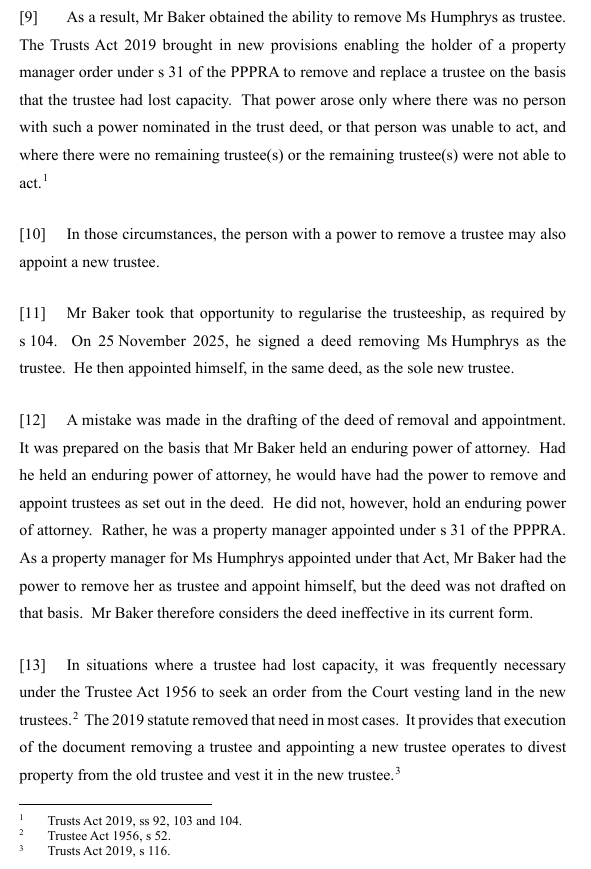
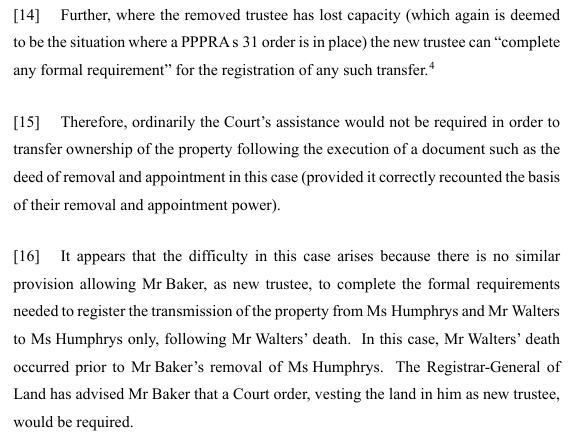
Orders Sought
Mr Baker sought rectification of the deed that misdescribed the basis for the power he purported to execute; and a vesting order. With respect to the vesting order as noted by Arthur J at [19] and [20]:
[19] The basis of the vesting order is less clear. Because of the reforms I have explained above, there is no equivalent in the 2019 statute to s 52 of the Trustee Act 1956. There is no express provision permitting the Court to order a vesting of any property. No clear authority or statutory provision has been put to me as the basis for the Court’s power to vest the land in a new trustee.
[20] Accordingly, I raised with counsel a different way of obtaining the outcome that Mr Baker seeks. That is, to treat the application as seeking an order declaring that Mr Walters is no longer a trustee, removing Ms Humphrys as trustee and appointing
Mr Baker as the sole trustee. The Court has the power to make such orders where it is “necessary or desirable”. Such an order will operate as a vesting order for the purposes of the Land Transfer Act 2017…”
Should the orders be made?
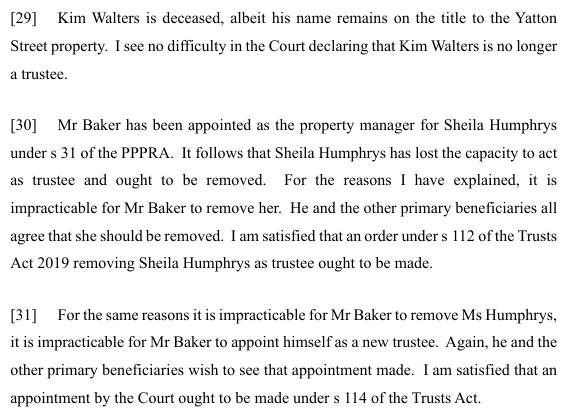
A pragmatic approach was adopted. As set out at [29] to [31]:
References:
- Baker v Humphreys [2026] NZHC 2054
References:
 Matters of Trust
Discussion
No comments yet.