The subject matter of Sunde v Sunde, is directions as to the order of the exchange and hearing of evidence on account of an application for probate in solemn form. As set out at [2] to [4]:
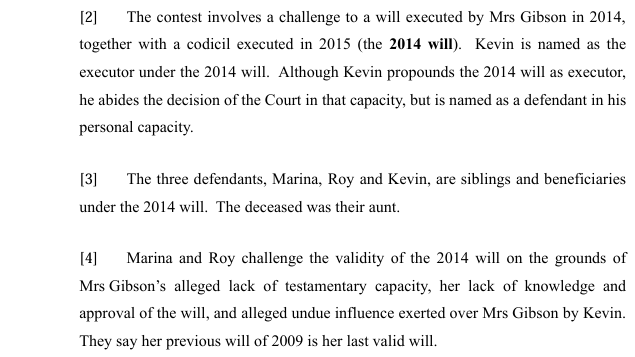
By way of further background as noted at [13]:
[13] In probate proceedings, it is generally presumed that the maker of a will apparently rational on its face has testamentary capacity. Those propounding the will are not required to establish the testator had testamentary capacity. However, where there is some evidence that raises lack of capacity as a tenable issue, the onus of satisfying the Court that the maker of the will did have testamentary capacity shifts to the person seeking probate.
It is not necessary to prove testamentary capacity in probate proceedings unless there is some evidence raising lack of capacity as a tenable issue: Bishop v O’Dea.
In the absence of such evidence, the maker of a will apparently rational on its face, will be presumed to have testamentary capacity: Bishop v O’Dea.
Once capacity is in issue, then onus then shifts to the person propounding the will to establish the will-maker’s capacity on the balance of probabilities: Li v Smith.
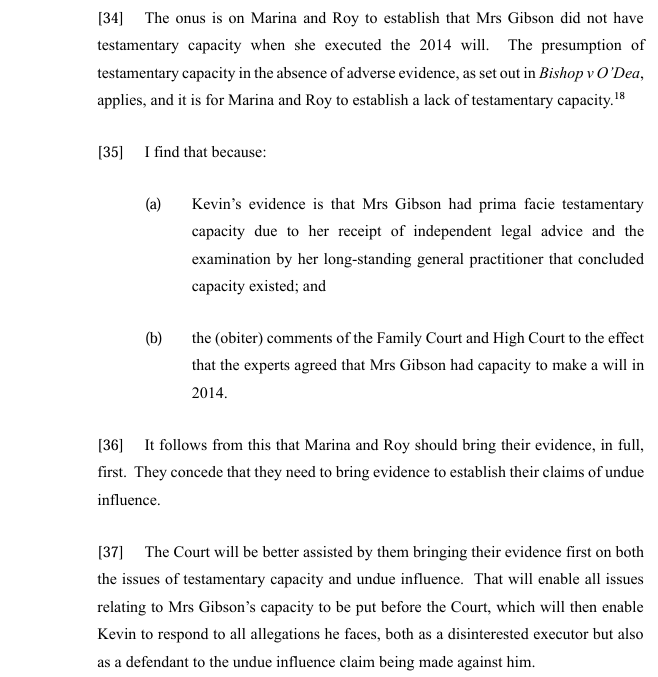
Where a will appears rational on its face the will-maker will be presumed to have testamentary capacity unless there is some evidence raising lack of capacity as a tenable issue. However, once capacity is in issue, then onus then shifts to the person propounding the will to establish the will-maker’s capacity on the balance of probabilities. Ordinarily the will-maker’s execution of a will is sufficient evidence of knowledge and approval of its contents. See Re Whyte (dec’d) at 520. That said, where the circumstances in which a will was prepared raises grounds for suspicion that the will does not express the testamentary intentions of the will maker, the onus lies on the person propounding the will to remove that suspicion. Once the person propounding the will removes that suspicion and proves the will maker knew and approved its contents, the onus is transferred to those opposing the will to prove undue influence (or whatever else they rely on). This is set out in Sunde v Sunde at [34] to [37] as follows:
References:
- Sunde v Sunde [2026] NZHC 3119
- Bishop v O’Dea (1999) 18 FRNZ 492
- Li v Smith [2026] NZCA 436
- Re Whyte (dec’d) [1969] NZLR 519


Discussion
No comments yet.