The background to Re Lake is a “show cause” hearing in relation to a caveat against probate. The will in question (the 2021 Will) provided for the deceased’s surviving children to share equally in his estate with no gift over for grandchildren. Previous wills made greater provision for the Cavator.
The named executors had obtained an order nisi. The caveator opposed the order being made absolute arguing that the 2021 Will was a product of undue influence resulting in a will that was less favourable to the caveator.
As noted by Dunningham J at [7] while the caveator has the onus of demonstrating whether there are sufficient grounds for a full enquiry, the threshold is recognised in Jurisich v Harris at [7] to be “fairly low.”
The background can be summarised as follows:
- the appointment to review the deceased’s prior will was the result of a law firm reminder that was stated to be sent to clients at three or five yearly intervals depending on the client’s life situation
- at the appointment, that the deceased attended with one of his children, he advised that he was considering a new will that did not favour the caveator as he was “fed up with the behaviour if [the caveator] towards him …”
- the legal executive who attended on the deceased had no concerns regarding his capacity and although the deceased’s daughter attended both appointments, she had no input into the instructions
- the caveator’s grounds as to undue influence included:
- his sister becoming close to the deceased
- that she was “overly involved in the changing of his will”
- taking his father (the deceased) to appointments
- failing mental faculties resulting in repeated errors at work
- the caveator was supported by affidavit from staff
- a different history was revealed by the executors who detailed a deteriorating relationship between the caveator and his father and their father’s partner. The caveator was convicted for assault against the father’s partner following an altercation between the caveator and his father’s partner at his father’s home
- the deceased’s daughter gave evidence that:
- she had no involvement in her father’s will and did not discuss the terms of this will with him
- he no health issues other than treatment for a melanoma in 2021 until he suffered a stroke in 2022
- her father withdrew from farm operation to minimise the caveator’s aggression
Importantly, the legal executive who was a registered legal executive who knew the deceased well confirmed that the deceased’s daughter did not have any input into her father’s instructions. Further the legal executive:
- satisfied that the deceased “had a “sound understanding of the facts and circumstances that related to his instructions for his new will”
- had no concerns as to the deceased’s capacity or understanding
- was aware that the deceased was “certainly frustrated, upset and disappointed with [the caveator’s] behaviour and/or attitude towards him” and it was clear there was “serious disharmony” between them
The legal executive was clear that the deceased “knew his own mind.” The legal executive also gave evidence that she did not agree with the instructions not to make provision for his grandchildren (one of his daughter’s died around the time he made the 2021 Will)
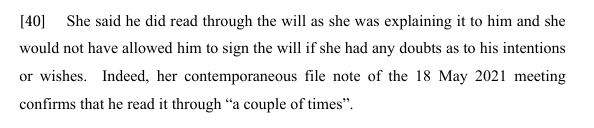
As stated at [40]:
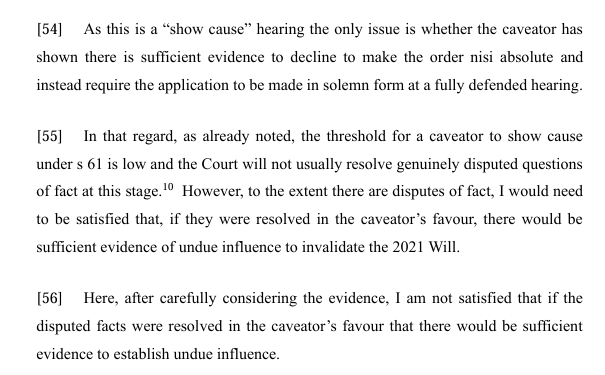
As set out at [54] to [56]:
The Court identified the essence of the caveator’s case, which was that an inference should be draft of undue influence due to a later will that is less favourable to the caveator. However, as stated at [58]:
- “unusually in this case, there is clear evidence of an alternative explanation” for Ron’s change of heart” for the new will
- difficult to see how “undue influence could be established on the balance of probabilities as the reason for the change reflected in the 2021 Will.”
While there was no formal assessment of capacity there was nothing to suggest a reasons to question capacity. There was no evidence that the deceased was dependent on his daughter when he made the 2021 will. In addition as set out at [63]:
“… this is not a case where the changes from the prior wills, looked at objectively, raise concerns. As drafted, the 2021 Will seeks to treat the living children equally which, but for the claim the farm was promised to [the Caveator] is an unsurprising decision, and would not normally be cause for concern.”
References:
- Re Lake [2026] NZHC 2367
- Jurisich v Harris [2016] NZHC 525 a
- Re Payne (1969) 2 PRNZ 432 (HC) at 433


Discussion
No comments yet.