The decision in Perpetual Trust v Cooke is the first appellate level consideration as to how the general duty of care in section 29 of the Trusts Act 2019 relates to the principle of non-intervention in discretionary trustee decisions. In Perpetual Trust v Cooke the Court of Appeal held that that section 29 is not a vehicle for a general merits review.
By way of background following a breakdown of the relationship between Perpetual Trust and Mr Cooke, a beneficiary of the estate to which Perpetual Trust has been appointed trustee, Perpetual Trust (also known as Perpetual Guardian) sought directions. Mr Cooke was largely successful in the High Court. This was summarised at [4] to [7] of the Cout of Appeal decision in the following terms:
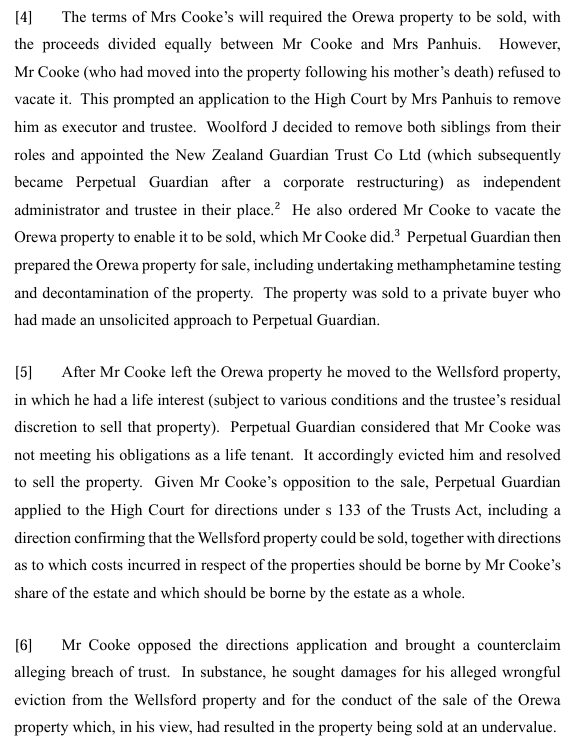

An overarching issue of the appeal was whether the correct legal standard had been applied when reviewing Perpetual Trust’s various actions and decisions.
Although Perpetual Trust’s actions straddled the introduction of the Trusts Act 2019, nothing was considered to turn on this.
The position adopted in the High Court was set out at [28] as follows:


The Court of Appeal accepted that the above summary overlooked the fact that Mr Cooke’s challenges related to discretionary decisions. As then stated at [29]:
“… We therefore first consider the standard of review that applies to discretionary trustee decisions, before turning to consider how this standard of review relates to the general duty of care under s 29 of the Trusts Act (as well as the duty of care that applied at common law, prior to the enactment of the Trusts Act).“
The Court of Appeal then went on to note some key principles regarding trustee decisions:
- Courts do not sit as appellate bodies with respect to trustee decisions
- There is a foundational “principle of non-intervention”
- Settlors entrust discretionary powers to trustees. Accordingly, the role of a court is supervisory whereby a court does not examine the underlying merit of a trustee decision or substitute its own judgment. Rather the court’s focus is on examining how the decision was reached, not whether the court would have reached the same decision.
- The established grounds for intervention mean that a court will only interfere with a discretionary decision if a trustee has:
- acted outside the scope of powers
- acted in bad faith or for an improper motive
- engaged in inadequate deliberation, or
- reached a decision that is perverse, capricious or irrational
- The standard for review of a trustee decision set out in section 126 of the Trusts Act provides for review of acts, omissions or decisions that were “not reasonably open to the trustee in the circumstances.”
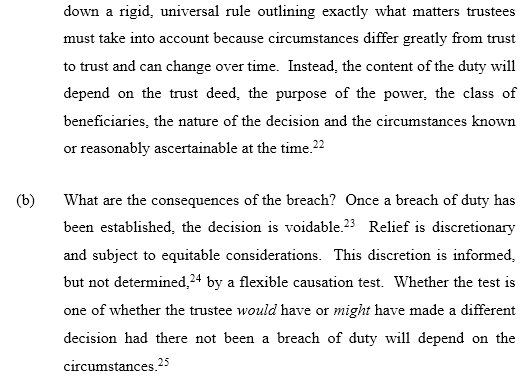
With respect to inadequate deliberation the Court of Appeal referenced the recent Privy Council decision in Dawson-Dalmer v Grampian Trust Company Limited and the earlier UK Supreme Court decision in Pitt v Holt noting at [33] that these cases suggest a two-step inquiry:

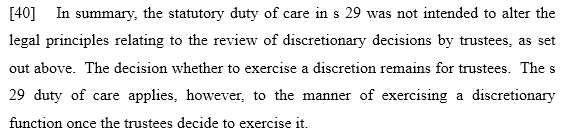
As then set out at [40]:
Vicki Ammundsen will be discussing the Court of Appeal decision in Perpetual Trust v Cooke in the Trust Series 2026 webinar – Trustees Duties and Powers.
References:
- Perpetual Trust v Cooke [2026] NZCA 349
- Perpetual Trust v Cooke [2024] NZHC 1779
- Trusts Act 2019, ss 29, 126, 127
- Dawson-Damer v Grampian Trust Co Ltd [2025] UKPC 32
- Pitt v Holt [2014] UKSC 26


Discussion
No comments yet.